4. Trotter-Suzuki Decomposition of \(U(t)\)
In this notebook we introduce the Trotter-Suzuki decomposition to approximate the time-evolution operator \(U(t) = \exp(-i H t)\) for a Hamiltonian \(H\). We study the error and cost of the approximation. We take the nearest-neighbor 1D Heisenberg Hamiltonian to illustrate the method. We consider first- and second-order Trotter-Suzuki formulas.
4.1. Introduction
We start by introducing the general idea of Trotterization. We would like to compute the exponential of an operator \(H\). For small systems, it can be computed exactly by \(\texttt{quimb}\) or \(\texttt{scipy}\) linear algebra methods. In the \(\texttt{qpe-toolbox}\), the method get_U_exact of the Hamiltonian class returns the quantum gate implementing the exact time evolution using \(\texttt{quimb}\)’s expm matrix exponentiation routine. For larger systems, however, computing the exact exponential is too expensive and we need to use approximations such as Trotterization.
Let us decompose the operator as \(H = A + B\). In practice, we decompose the Hamiltonian into a sum of operators whose exponentiation can easily be implemented, e.g. Pauli strings. When \(A\) and \(B\) commute, as scalars do, the exponential of the sum is the product of exponentials:
but in general \(A\) and \(B\) do not commute, hence the previous expression does not hold. Trotterization provides an approximation of the exponential of a sum based on the Baker-Campbell-Hausdorff formula.
The Trotter product formula gives the following expression:
import matplotlib.pyplot as plt
import numpy as np
import quimb as qu
import quimb.tensor as qtn
from tqdm import notebook as tqdm

from qpe_toolbox.hamiltonian import heisenberg_hamiltonian
plt.rcParams.update({"font.size": 12})
Now consider a general Hamiltonian, written as a sum of generally non-commuting terms:
In this example, we take a 1D Heisenberg Hamiltonian with \(n=4\) spins and open boundary conditions. We want to compute the time-evolution operator \(U(t) = \exp(-iHt)\). Let us split the time interval into \(r\) timesteps of size \(t/r\).
n_qubits = 4
id2n = qu.eye(2**n_qubits)
h_spin = heisenberg_hamiltonian(n_qubits)
h_dense = h_spin.to_dense()
data_reg = list(range(n_qubits))
4.1.1. First-order Trotter-Suzuki Formula
Trotter-Suzuki decompositions of increasing order approximate \(U\) with increasing precision. The first-order Trotter-Suzuki decomposition is given by:
Over the full evolution time \(t\), errors accumulate:
so that the error is linear in the timestep \(\delta t \equiv t/r\).
4.1.2. Second-order Trotter-Suzuki Formula
Higher-order decompositions can be obtained recursively. Here we go up to the second-order Trotter-Suzuki decomposition:
which gives:
The error is now quadratic in \(\delta t\).
In \(\texttt{qpe-toolbox}\), first- and second-order Trotterization are implemented by the get_trotter_step method of the Hamiltonian class.
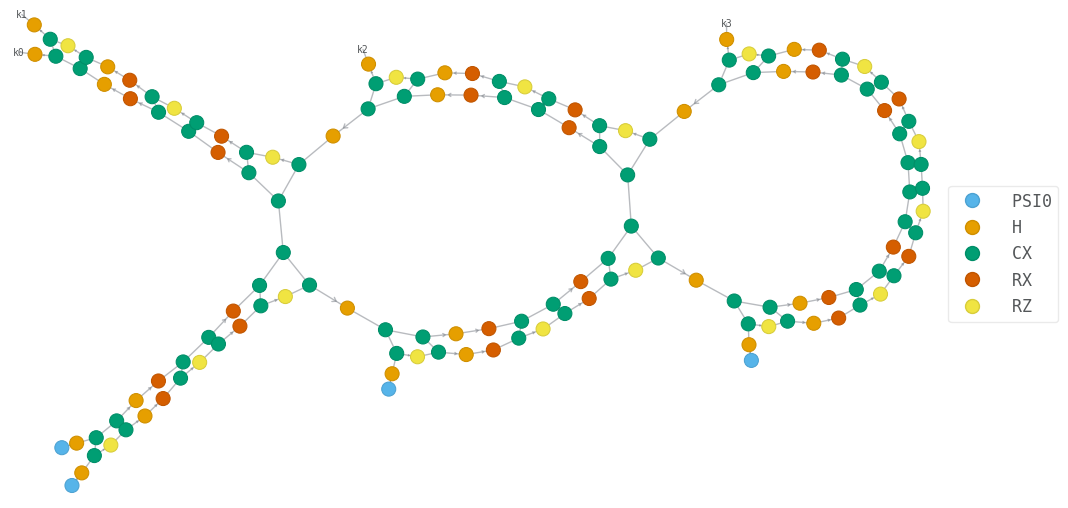
Below, we visualize the circuits for one timestep:
# First-order Trotter
dt = 1
trotter_routine = h_spin.get_trotter_step(dt, data_reg, trotter_order=1)

circ = qtn.Circuit(n_qubits)
circ.apply_gates(trotter_routine)
circ.draw(figsize=(14, 14))
circ.psi.draw(figsize=(12, 12), color={"PSI0", "H", "RX", "RZ", "CX"})


# Second-order Trotter
trotter_routine = h_spin.get_trotter_step(dt, data_reg, trotter_order=2)

circ = qtn.Circuit(n_qubits)
circ.apply_gates(trotter_routine)
circ.draw(figsize=(14, 14))
circ.psi.draw(figsize=(12, 12), color={"PSI0", "H", "RX", "RZ", "CX"})

4.2. Trotter Error: Full Unitary Distance as a Metric
Let us first use the distance between the full time-evolution operators as a metric: \(||U_{\rm exact}^{\dagger}(t_f) U_{\rm Trotter}(t_f) - \mathbb{1}||\)
We define a function that collects the errors for evolution times \(t\) in t_values, numbers of timesteps \(n_{\rm steps}\) in n_steps_values, and Trotterization order trotter_order.
NB: in this example we consider the Frobenius norm to define the error. Any other norm supported by quimb.norm can be used via the optional parameter ntype.
def errors_trotter_slice(t_values, n_steps_values, trotter_order, ntype="fro"):
    n_t = len(t_values)
    n_n = len(n_steps_values)
    errors = np.empty((n_t, n_n))

    for i in tqdm.tqdm(range(n_t)):
        U_exact = qu.expm(-1j * t_values[i] * h_dense)

        for j in tqdm.tqdm(range(n_n), leave=False):
            circ = qtn.Circuit(n_qubits)
            dt = t_values[i] / n_steps_values[j]
            trotter_slice = h_spin.get_trotter_step(dt, data_reg, trotter_order)
            for _ in range(n_steps_values[j]):
                circ.apply_gates(trotter_slice)
            U_trotter = circ.get_uni().to_dense()

            errors[i, j] = qu.norm(U_exact.H @ U_trotter - id2n, ntype=ntype)

    return errors
We consider a sequence of evolution times growing as powers of \(2\) as in QPE: \(t_f = 2^kt_0, k = 0 \dots 5\). Following the convention discussed in Textbook QPE, we pick \(t_0 = 2\pi/\Delta\), where \(\Delta = 10\) is the width of the energy search window. We vary the number of Trotter steps between \(5\) and \(200\).
Δ = 10
t0 = 2 * np.pi / Δ
t_values = t0 * 2 ** np.arange(6)
n_steps_values = np.array([5, 10, 50, 100, 200])
4.2.1. First-order Trotter
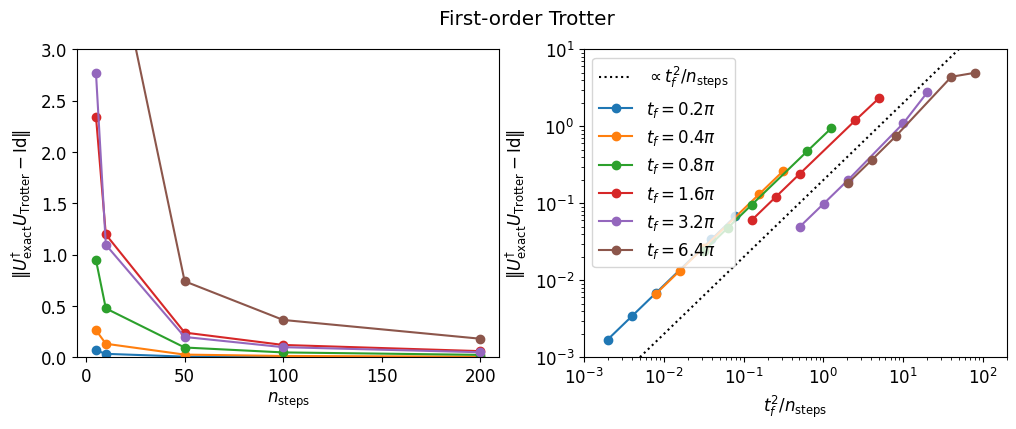
Let us start with first-order Trotter. The following cell should take a minute to run:
errors_1st = errors_trotter_slice(t_values, n_steps_values, trotter_order=1)
As seen in the introduction, we expect the error to scale as \(t_f^2 / n_{\rm steps}\). Let us plot the errors versus \(n_{\rm steps}\) (left, linear scale) and versus \(t_f^2 / n_{\rm steps}\) (right, log scale):
fig, (axl, axr) = plt.subplots(ncols=2, figsize=(12, 4))
xfit = np.linspace(1e-5, 100, 101)
axr.loglog(xfit, 0.2 * xfit, ":k", label=r"$\propto {t_f^2}/{n_{\text{steps}}}$")
for i, t in enumerate(t_values):
    axl.plot(n_steps_values, errors_1st[i], "-o")
    axr.loglog(
        t**2 / n_steps_values, errors_1st[i], "-o", label=rf"$t_f={t / np.pi:.2g}\pi$"
    )

axl.set_ylim(0, 3)
axr.set_xlim(1e-3, 2e2)
axr.set_ylim(1e-3, 10)
axr.legend(loc="upper left")
axl.set_xlabel(r"$n_{\text{steps}}$")
axr.set_xlabel(r"${t_f^2}/{n_{\text{steps}}}$")
axl.set_ylabel(r"$\| U_{\mathrm{exact}}^\dag U_{\mathrm{Trotter}} - \mathrm{Id} \|$")
axr.set_ylabel(r"$\| U_{\mathrm{exact}}^\dag U_{\mathrm{Trotter}} - \mathrm{Id} \|$")
fig.suptitle("First-order Trotter");
4.2.2. Second-order Trotter
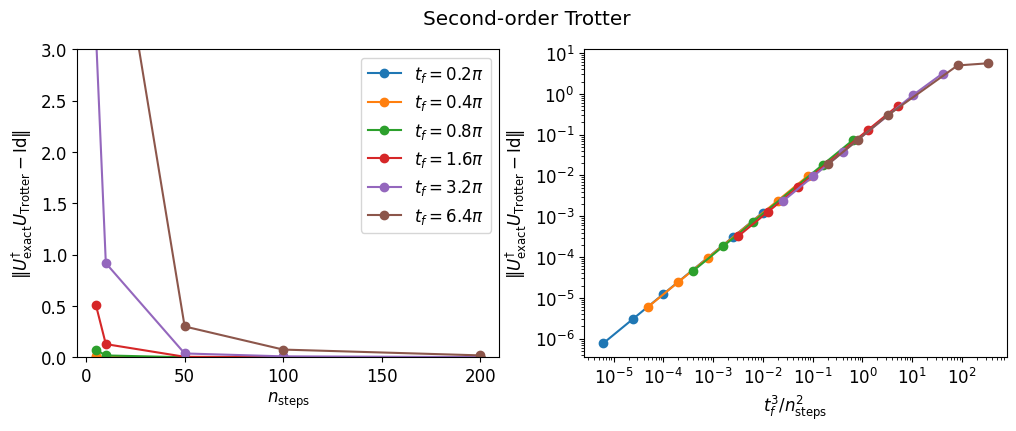
Similarly, we plot the errors reached with a second-order Trotter formula, as a function of \(n_{\rm steps}\) (left, linear scale) and as a function of \(t_f^3 / n_{\rm steps}^2\) (right, log scale).
errors_2nd = errors_trotter_slice(t_values, n_steps_values, trotter_order=2)
fig, (axl, axr) = plt.subplots(ncols=2, figsize=(12, 4))
for i, t in enumerate(t_values):
    axl.plot(n_steps_values, errors_2nd[i], "-o", label=rf"$t_f={t / np.pi:.2g}\pi$")
    axr.loglog(t**3 / n_steps_values**2, errors_2nd[i], "-o")

axl.set_ylim(0, 3)
axl.legend()
axl.set_xlabel(r"$n_{\text{steps}}$")
axr.set_xlabel(r"${t_f^3}/n_{\text{steps}}^2$")
axl.set_ylabel(r"$\| U_{\mathrm{exact}}^\dag U_{\mathrm{Trotter}} - \mathrm{Id} \|$")
axr.set_ylabel(r"$\| U_{\mathrm{exact}}^\dag U_{\mathrm{Trotter}} - \mathrm{Id} \|$")

fig.suptitle("Second-order Trotter");
4.2.3. Number of Steps Required to Get Below a Given Error
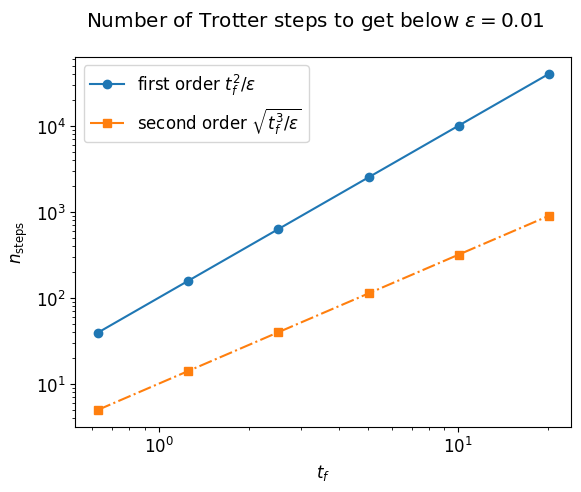
For the first-order Trotter formula, since the error scales as \(t_f^2 / n_{\rm steps}\), reaching an error \(\epsilon\) requires a minimum number of steps:
Since in QPE the maximum evolution time is \(t_f = \mathcal{O} (2^m)\) where \(m\) is the number of phase bits, we get
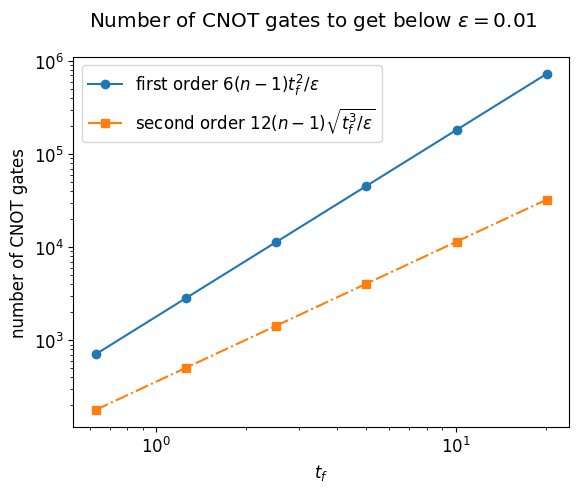
As shown in the plot below, the number of Trotter steps quickly grows beyond \(10^4\), which translates into almost a million CNOT gates. This is why in practice we use the second-order Trotter decomposition.
The Trotter error at second order is \(\mathcal{O}(t_f^3 / n_{\rm steps}^2)\). Thus reaching an error \(\epsilon\) requires a number of steps scaling as
Again with the QPE maximum evolution time \(t_f = \mathcal{O} (2^m)\), we get
epsilon = 1e-2

fig, ax = plt.subplots()
ax.loglog(t_values, t_values**2 / epsilon, "-o", label=r"first order $t_f^2/\epsilon$")
ax.loglog(
    t_values,
    np.sqrt(t_values**3 / epsilon),
    "-.s",
    label=r"second order $\sqrt{t_f^{3}/\epsilon}$",
)
ax.set_xlabel(r"$t_f$")
ax.set_ylabel(r"$n_{\text{steps}}$")
ax.legend()
fig.suptitle(f"Number of Trotter steps to get below $\\epsilon = {epsilon}$");
4.2.4. Number of CNOT Gates Required to Get Below a Given Error
Here we investigate the number of entangling gates required to run a Trotter time evolution within a given error bound \(\epsilon\).
The Trotter decomposition expresses the evolution operator as a product of exponentials of Pauli strings. Let us describe the algorithm for the exponentiation of Pauli strings.
4.2.4.1. Quantum Circuit for Exponentiation of Pauli Strings
The different terms in the Hamiltonian can be written as Pauli strings, i.e. using the Pauli operator basis:
where \(n\) is the number of qubits required to represent the Hilbert space.
Here we present the algorithm to exponentiate \(H_\ell\), i.e. to encode \( e^{-i H_\ell t} = e^{ -i t U_1 \otimes U_2 \otimes \dots \otimes U_n }. \) A mathematical proof of a similar algorithm can be found in Fleury, Lacomme, Quantum circuit for exponentiation of Hamiltonians: an algorithmic description based on tensor products, arXiv:2501.17780.
Let us first state the following two properties:
\( e^{-i t Z} = R_Z(2t) \) by definition.
\( e^{-i t Z_{i_1} Z_{i_2} \dots Z_{i_M}} = CX_{i_1 i_2} CX_{i_2 i_3} \dots CX_{i_{M-1} i_M} \left( \mathbb{1}^{\otimes (i_M-1)} \otimes R_Z(2t) \otimes \mathbb{1}^{\otimes (n - i_M - 1)} \right) CX_{i_{M-1} i_M} CX_{i_{M-1} i_{M-2}} \dots CX_{i_1 i_2} \) (see arXiv:2501.17780).
The algorithm proceeds as follows:
First, apply basis rotations to bring all qubits into the \(Z\) basis:
if \(U_k=X\), apply a Hadamard gate \(H\) to the \(k\)-th qubit.
if \(U_k=Y\), apply a rotation gate \(R_X(\pi/2)\) to the \(k\)-th qubit.
Then, apply a sequence of CNOT gates between qubits \(i_k\) and \(i_{k+1}\), where \(i_k\) are the indices of non-identity operators in the string.
Apply \(R_Z(2t)\) to the last qubit on which a non-identity Pauli operator is acting.
Apply the reversed CNOT sequence.
Bring the qubits back to their original basis by applying the inverse rotations.
This algorithm is executed by the rotation_gates function from \(\texttt{qpe-toolbox}\)’s hamiltonian module.
4.2.4.2. CNOT Gate Count
Thus, the algorithm to implement a Pauli string exponential \(\exp(-i \theta P_1 ... P_K )\), where the \(P_i \in \{X,Y,Z\}\) are non-identity Pauli operators, uses \(2 (K - 1)\) CNOT gates, \(K\) being the length of the Pauli string.
For the Heisenberg Hamiltonian:
with the normalization \(S^\alpha = \sigma^\alpha/2\), so that \(H = J\sum_i \mathbf{S}_i\cdot\mathbf{S}_{i+1}\).
One Trotter slice (first order):
is thus implemented with \(6(n-1)\) CNOT gates (3 axes, each contributing a length-2 Pauli string).
This gives a total CNOT gate count for the Trotterization of \(U(t)\):
Second order:
Total CNOT gate count for second-order Trotterization:
Note that the two neighboring \(e^{-i Z_{n-2} Z_{n-1} dt J/8}\) terms could be merged, as well as the \(e^{-i X_0 X_1 dt J/8}\) terms from neighboring Trotter steps, to reduce the total CNOT gate count. Here we only implement the most naive version of second-order Trotterization: in general, one should merge the two occurrences of the last Hamiltonian term.
fig, ax = plt.subplots()
ax.loglog(
    t_values,
    6 * (n_qubits - 1) * t_values**2 / epsilon,
    "-o",
    label=r"first order $6(n-1)t_f^2/\epsilon$",
)
ax.loglog(
    t_values,
    12 * (n_qubits - 1) * np.sqrt(t_values**3 / epsilon),
    "-.s",
    label=r"second order $12(n-1)\sqrt{t_f^{3}/\epsilon}$",
)
ax.set_xlabel(r"$t_f$")
ax.set_ylabel(r"number of CNOT gates")
ax.legend()
fig.suptitle(f"Number of CNOT gates to get below $\\epsilon = {epsilon}$");
4.3. Fidelity as an Error Metric
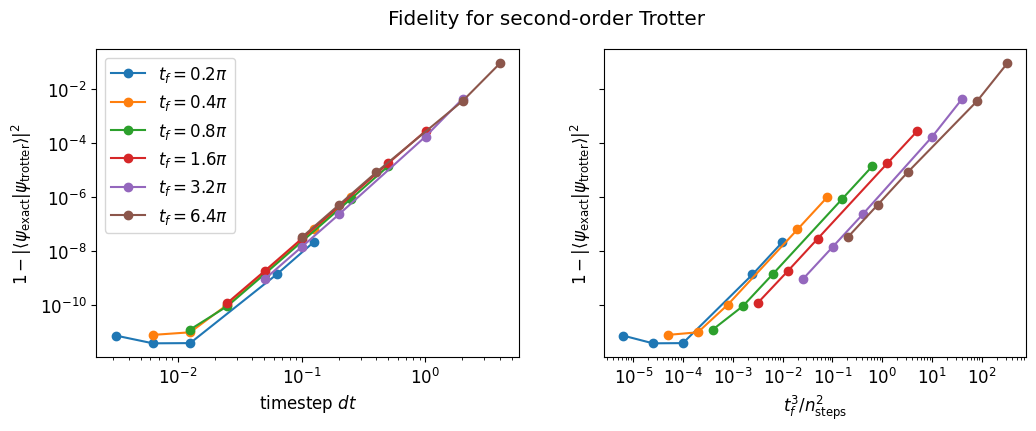
In a QPE experiment, we are interested in the time evolution of a Hamiltonian eigenstate. Let us therefore use the quantum fidelity, defined as \(|\langle\psi_{\rm exact}(t) | \psi_{\rm trotter}(t)\rangle|^2\), as an error metric. We consider the second-order Trotter decomposition.
def fidelities_trotter_slice(t_values, n_steps_values, trotter_order):
    n_t = len(t_values)
    n_n = len(n_steps_values)
    errors = np.empty((n_t, n_n))

    _eigvals, eigvecs = np.linalg.eigh(h_dense)
    psi0 = eigvecs[:, 0]
    psi0_mps = qtn.MatrixProductState.from_dense(psi0)
    circ0 = qtn.Circuit(n_qubits, psi0=psi0_mps)

    for i in tqdm.tqdm(range(n_t)):
        U = qu.expm(-1j * t_values[i] * h_dense)
        psi_ref = U @ psi0

        for j in tqdm.tqdm(range(n_n), leave=False):
            circ = circ0.copy()
            dt = t_values[i] / n_steps_values[j]
            trotter_slice = h_spin.get_trotter_step(dt, data_reg, trotter_order)
            for _ in range(n_steps_values[j]):
                circ.apply_gates(trotter_slice)

            errors[i, j] = abs(
                1 - qu.fidelity(circ.psi.to_dense(), psi_ref, squared=True)
            )
    return errors
errors_fidelity = fidelities_trotter_slice(t_values, n_steps_values, trotter_order=2)
fig, (axl, axr) = plt.subplots(ncols=2, figsize=(12, 4), sharey=True)
for i, t in enumerate(t_values):
    axl.loglog(
        t / n_steps_values,
        errors_fidelity[i],
        "-o",
        label=rf"$t_f={t / np.pi:.2g}\pi$",
    )
    axr.loglog(t**3 / n_steps_values**2, errors_fidelity[i], "-o")

axl.legend()
axl.set_xlabel("timestep $dt$")
axl.set_ylabel(r"$1-|\langle\psi_{\rm exact} | \psi_{\rm trotter}\rangle|^2$")
axr.set_ylabel(r"$1-|\langle\psi_{\rm exact} | \psi_{\rm trotter}\rangle|^2$")
axr.set_xlabel(r"${t_f^3}/n_{\text{steps}}^2$")
fig.suptitle("Fidelity for second-order Trotter");
This ends our simple introduction to the Trotter-Suzuki decomposition. For the reader interested in going further, we refer to this paper by Andrew M. Childs that gives a theoretical study of Trotter error with a focus on Hamiltonian simulation.