7. Robust Phase Estimation
In the previous notebooks, we used the “textbook” (sometimes called “canonical”) version of QPE, which requires multiple qubits in the phase register as well as an inverse Quantum Fourier Transform. Logical qubits are expected to remain a scarce resource on early fault-tolerant quantum computers, therefore we are interested in a formulation that requires less qubits. Over the years, many single-ancilla variants of QPE have been proposed, starting with Kitaev’s Iterative Quantum Phase Estimation (IQPE). In this notebook, we introduce one such variant: Robust Phase Estimation (RPE). Like IQPE, RPE requires only a single ancilla qubit. However, it differs in how it reconstructs the phase from the measurement outcomes. Our implementation is inspired by J. Günther et al., Phase Estimation with Partially Randomized Time Evolution, PRX Quantum 7, 020332.
In this notebook we explain the idea of the algorithm and apply it to simple models: the Heisenberg model with \(4\) spins, the H\(_2\) molecule in the minimal basis. We study the statistical errors and check that the RPE algorithm satisfies Heisenberg scaling, i.e. the ability to measure the energy with precision \(\varepsilon\) in time \(\mathcal{O}(1/\varepsilon)\).
import time

import matplotlib.pyplot as plt
import numpy as np
import quimb.tensor as qtn
from pyscf import gto
from tqdm import notebook as tqdm

import qpe_toolbox.estimation as qpe
from qpe_toolbox import EXACT
from qpe_toolbox.hamiltonian import (
    chemistry_hamiltonian,
    do_dmrg,
    heisenberg_hamiltonian,
)
plt.rcParams.update({"font.size": 12})
7.1. Hadamard Test
The Robust Phase Estimation algorithm relies on the Hadamard test procedure, which we introduce below. Our presentation takes inspiration from Lin Lin’s lecture notes and the “Hadamard test” Wikipedia page.
The goal of the Hadamard test is to compute \(\bra{\psi} U \ket{\psi}\) where \(U\) is a unitary operator. Since \(U\) is generally not Hermitian, it is not an observable; therefore the real and imaginary parts of \(\bra{\psi} U \ket{\psi}\) must be measured separately.
The idea is to build a random variable whose expectation value gives the real (resp. imaginary) part of \(\bra{\psi} U \ket{\psi}\). Consider the following circuit:
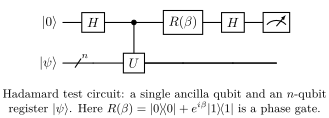
The Hadamard test uses a single auxiliary qubit initially in state \(\ket{0}\) and a physical register with \(n_{\rm qubits}\) qubits initialized in state \(\ket{\psi}\). We start by applying the Hadamard gate \(H\) to the auxiliary qubit to put it in a superposition state. Then we apply a controlled-\(U\) gate to the physical register conditioned on the auxiliary qubit, followed by a rotation (PHASE) gate \(R(\beta)\) and finally another Hadamard gate on the control qubit.
At the end of the circuit we measure the control qubit and define a random variable \(\textbf{Z}_\beta\): if the result of the measurement is \(\ket{0}\), we output \(1\), if the result is \(\ket{1}\), we output \(-1\). The expectation value of \(\textbf{Z}_\beta\) satisfies:
We use two special choices of \(\beta\):
Let \(\textbf{X}\) and \(\textbf{Y}\) be the random variables corresponding to \(\beta=0, -\pi/2\) respectively. Define \(\textbf{Z} = \textbf{X} + i \textbf{Y}.\) Then we get
Let us first illustrate a simple instance of the Hadamard test with \(U = |0\rangle \langle 0| + e^{i\alpha} |1\rangle \langle 1|\) and \(|\psi\rangle = |1\rangle\).
alpha = np.pi / 6
print(f"cos(alpha) = {np.cos(alpha):.4g} and sin(alpha) = {np.sin(alpha):.4g}")

# Hadamard test with β=0
circ = qtn.Circuit(2)
circ.apply_gate("X", 1)
circ.apply_gate("H", 0)
circ.apply_gate("CPHASE", alpha, 0, 1)
circ.apply_gate("H", 0)

probs = circ.compute_marginal(where=[0])
print(f"Re(<psi|U|psi>) = {probs[0] - probs[1]:.4g}")

# Hadamard test with β=-pi/2
circ = qtn.Circuit(2)
circ.apply_gate("X", 1)
circ.apply_gate("H", 0)
circ.apply_gate("CPHASE", alpha, 0, 1)
circ.apply_gate("PHASE", -np.pi / 2, 0)
circ.apply_gate("H", 0)

probs = circ.compute_marginal(where=[0])
print(f"Im(<psi|U|psi>) = {probs[0] - probs[1]:.4g}")
cos(alpha) = 0.866 and sin(alpha) = 0.5
Re(<psi|U|psi>) = 0.866
Im(<psi|U|psi>) = 0.5
Now take the Heisenberg Hamiltonian with \(4\) spins
n_qubits = 4
H = heisenberg_hamiltonian(n_qubits)
E0, psi0 = do_dmrg(H)
We run the Hadamard test on the time evolution operator \(U = e^{-iHt}\) with the physical register in state \(\ket{\psi} = \ket{\psi_0}\). Then
The function run_hadamard_test runs the Hadamard test and returns \(\mathrm{Re}~e^{i\beta} \bra{\psi}U\ket{\psi}\).
Below we estimate \(E_0\) by running the Hadamard test for time evolution over a given time \(t\).
We first consider exact time evolution.
t0 = 1.0  # equivalent to Hamiltonian scaling factor
data_reg = list(range(1, n_qubits + 1))
U = H.get_U_exact(t0, data_reg, controls=(0,))

n_shots = EXACT  # exact computation (no sampling)

X = qpe.run_hadamard_test(psi0, U, 0, n_shots)
Y = qpe.run_hadamard_test(psi0, U, -np.pi / 2, n_shots)
Z = X + 1j * Y

print(f"error = {abs(np.angle(Z) / t0 + E0):.2g}")
error = 4.4e-08
The previous relation defines a function \(g: t \to \mathbb{E}\textbf{Z}(t) \).
At this stage let us emphasize two points:
In general:
In the following, we consider the simplest case \(c_0=1\) (\(\psi\) is the ground state).
With a QPU emulator like \(\texttt{quimb}\), the probabilities \(P(0)\), \(P(1)\) can be computed exactly. On a real quantum device, these probabilities are estimated from repeated measurements (shots). With a finite number of shots \(n_{\rm shots}\), we can estimate \(g(t)\) by taking the statistical mean over \(n_{\rm shots}\) samples:
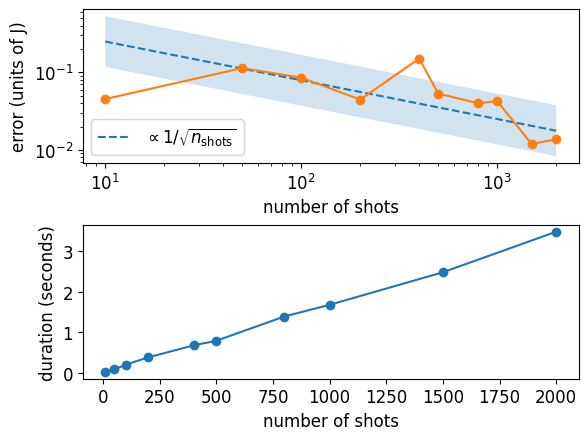
If \(n_{\rm shots}\) shots are used, the statistical error scales as
shot_counts = np.array([10, 50, 100, 200, 400, 500, 800, 1000, 1500, 2000])
errors = []
durations = []
rng = np.random.default_rng(42)

for n_shots in tqdm.tqdm(shot_counts):
    st = time.time()
    X = qpe.run_hadamard_test(psi0, U, 0, n_shots, rng=rng)
    Y = qpe.run_hadamard_test(psi0, U, -np.pi / 2, n_shots, rng=rng)
    et = time.time() - st

    Z = X + 1j * Y
    error = abs(np.angle(Z) / t0 + E0)

    errors.append(error)
    durations.append(et)
The statistical error decreases as \(1/\sqrt{n_{\rm shots}}\) while the computation time increases linearly with \(n_{\rm shots}\).
log_prefactor = np.log(errors) + np.log(shot_counts) / 2
mean = np.exp(log_prefactor.mean())
std = np.exp(log_prefactor.std())
fig, (ax_e, ax_t) = plt.subplots(nrows=2)
fig.subplots_adjust(hspace=0.4)
ax_e.loglog(
    shot_counts,
    mean / np.sqrt(shot_counts),
    "--",
    label="$\\propto 1/\\sqrt{n_{\\rm shots}}$",
)
ax_e.fill_between(
    shot_counts,
    mean / std / np.sqrt(shot_counts),
    mean * std / np.sqrt(shot_counts),
    alpha=0.2,
)
ax_e.loglog(shot_counts, errors, "-o")

ax_t.plot(shot_counts, durations, "-o")
ax_e.legend(loc="lower left")
ax_e.set_xlabel("number of shots")
ax_t.set_xlabel("number of shots")
ax_e.set_ylabel("error (units of J)")
ax_t.set_ylabel("duration (seconds)");
7.2. Robust Phase Estimation Algorithm
7.2.1. Introduction
In the previous section, we defined a function \(g(t) = \mathbb{E}[\mathbf{Z}(t)] = \bra{\psi} U(t) \ket{\psi}\) is computed using the Hadamard test. In this section, we explain how to process this function within the Quantum Phase Estimation algorithm.
Quote from Günther et al. PRX Quantum 7, 020332:
“If we think of g(t) as a time signal, then the phase estimation routine will constitute a signal processing transformation to compute the lowest frequency of \(g(t)\) (corresponding to the energy \(E_0\)), provided that we have some guarantee on the overlap of \(\ket{\psi}\) with the ground state; we assume a lower bound \(c_0 \geq \eta\). With appropriate signal processing methods, one can find the value of \(E_0\) with accuracy \(\varepsilon\) using \(M\) circuits with time evolution for times \(t_1, . . . , t_M\). This can be done such that the maximal time evolution \(t_{\rm max} = \mathrm{max}\{t_1, . . . , t_M\}\) and the total time over all circuit runs \(t_{\rm tot} = t_1 + t_2 + · · · + t_M\) both scale as \(\varepsilon^{-1}\). This Heisenberg scaling is known to be optimal.”
7.2.2. Description of the Algorithm
We introduce a base evolution time \(t_0\) and target the exact phase \(\theta_{\rm ex} = E_0 t_0\). This evolution time can be seen as a scaling factor for the Hamiltonian. To get precision \(\varepsilon\) on \(\theta_{\rm ex}\), the idea of the robust phase estimation algorithm is to consider \(M\) different circuits where \(M = \lceil \log_2 \varepsilon^{-1} \rceil\) and estimate
for \(m=0,1,..,M-1\). At each step the algorithm computes an estimate \(\theta_m\) of \(\theta_{\rm ex}\); the objective is that \(\theta_m\) be the best \(m\)-bit approximation of \(\theta_{\rm ex}\), so that each iteration adds one bit of precision.
Algorithm 1 (arXiv p.24 / PRX p.20)
The algorithm is initialized with \(\theta_{-1}=0\).
For each \(m\):
Take \(n_{\rm shots}\) samples to compute the average:
\[ \bar{\bf Z}(2^m t_0 ) = \frac{1}{n_{\rm shots}} \sum_{n=1}^{n_{\rm shots}} {\bf Z}^{(n)} (2^m t_0) \]From the outcome we compute \(\phi_m = - \arg(\bar{Z}(2^m t_0))\)
By definition \(\phi_m \in (-\pi, \pi]:~\phi_m~\) is an approximation of \(2^m \theta_{\rm ex}\) modulo \(2\pi\)
Given a previous guess \(\theta_{m-1}\) for the phase \(\theta_{\rm ex}\), the new estimate \(\theta_m\) is given by
\[ \theta_m = 2^{-m} (2\pi k + \phi_m), \]where \(k\) is an integer between \(0\) and \(2^m - 1\) chosen such that \(\theta_m \) minimizes the distance
\[ d(\theta_m, \theta_{m-1}) = \min_{q\in\mathbb{Z}} | \theta_m - \theta_{m-1} + 2\pi q|, \]under the condition \(-\pi < \theta_m \leq \pi\).
The algorithm ensures that at each step, \(\theta_m\) is indeed the best \(m\)-bit approximation of \(\theta_{\rm ex}\). The following lemma guarantees convergence:
Lemma B.1. (arXiv p.25 / PRX p.21): if \(d(\phi_m,2^{m}\theta_{\rm ex})<\frac{\pi}3\) for \(m=0,1,...,M -1\) then \(\theta_m\) is such that \(d(\theta_m,\theta_{\rm ex}) \leq 2^{-m}\frac{\pi}3\)
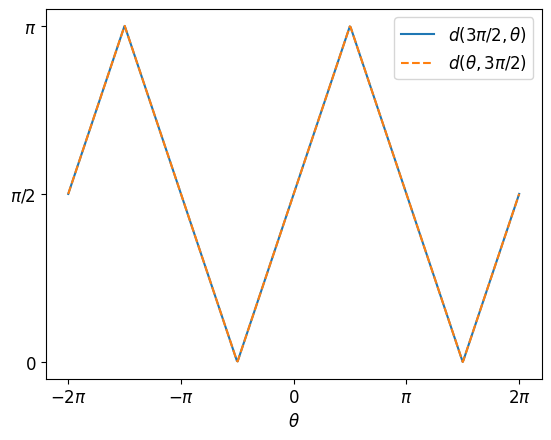
To build an intuition, let us plot the distance \(d(\theta, \phi)\) as a function of \(\theta\) for a given \(\phi\) (e.g. \( \phi = 3\pi/2\)) and vice-versa (the distance is symmetric by definition).
thetas = np.linspace(-2 * np.pi, 2 * np.pi, 600)
plt.xticks(
    np.pi * np.arange(-2, 3), [r"$-2\pi$", r"$-\pi$", "$0$", r"$\pi$", r"$2\pi$"]
)
plt.yticks([0, np.pi / 2, np.pi], ["0", r"$\pi/2$", r"$\pi$"])
plt.xlabel(r"$\theta$")

plt.plot(
    thetas, qpe.angular_distance(thetas, 3 * np.pi / 2), label=r"$d(3\pi/2, \theta)$"
)
plt.plot(
    thetas,
    qpe.angular_distance(3 * np.pi / 2, thetas),
    "--",
    label=r"$d(\theta, 3\pi/2)$",
)
plt.legend();
For simplicity we set the base evolution time \(t_0 = 1\) (default), the target phase is still \(\theta_{\rm ex} = E_0 t_0\). More generally, given a known energy window of width \(\Delta\) containing \(E_0\), the evolution time is chosen as \(t_0 = 2\pi/\Delta\) (together with a global phase) to map the spectrum into the unambiguous interval. See the Textbook QPE example for a discussion on the evolution time.
Let us now illustrate the first two steps of the algorithm for concreteness. We start with \(n_{\rm shots}=2\) and consider exact time evolution.
n_shots = 2
rng = np.random.default_rng(42)
t0 = 1.0
theta_exact = E0 * t0

# m = 0, evolution time = t0 * 2**0
phi_0 = qpe.rpe_get_hadamard_output(H, psi0, t0, EXACT, n_shots, rng=rng)
theta_0 = phi_0

m = 1
phi_1 = qpe.rpe_get_hadamard_output(H, psi0, t0 * 2**m, EXACT, n_shots, rng=rng)
possible_phases_looped = (phi_1 + 2 * np.pi * np.arange(2**m)) / 2**m
# candidate phases, wrapped into (-pi, pi]
possible_phases = (possible_phases_looped + np.pi) % (2 * np.pi) - np.pi
Let us visualize how the different possible phases compare to \(\theta_0\)
tfit = np.linspace(0, 1, 1001)
fig, ax = plt.subplots()
ax.plot(np.cos(2 * np.pi * tfit), np.sin(2 * np.pi * tfit), "-k", lw=1.8)
ax.plot(np.cos(theta_0), np.sin(theta_0), "gv", ms=12, label=r"$\theta_0$")
ax.plot(
    np.cos(possible_phases),
    np.sin(possible_phases),
    "o",
    markersize=15,
    label=r"possible $\theta_1$",
)
ax.plot(tfit * np.cos(theta_0), tfit * np.sin(theta_0), "-g")
for x in possible_phases:
    ax.plot(tfit * np.cos(x), tfit * np.sin(x), "--", color="tab:blue")
ax.plot(0, 0, "ok", ms=8)
ax.plot(
    np.cos(theta_exact), np.sin(theta_exact), "r*", ms=15, label=r"$\theta_{\rm ex}$"
)
ax.axis("off")
ax.set_aspect(1.0)
ax.legend(loc="upper right", bbox_to_anchor=(1.4, 1));
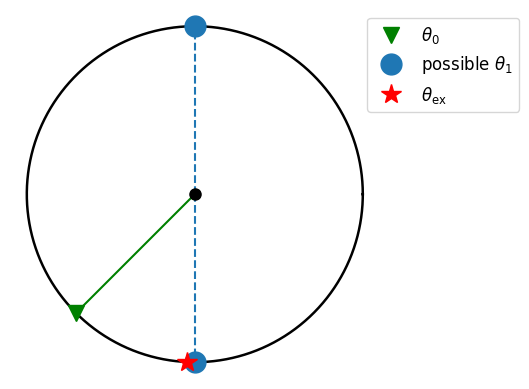
We compute \(\theta_1\) as the closest possible phase to \(\theta_0\) and check that the error decreases between the first and second iteration:
theta_1 = qpe.rpe_update_theta(phi_1, theta_0, m)
print(f"Target phase {theta_exact = :.4f}  (energy E0 = {theta_exact / t0:.4f})")
print(
    f"{theta_0 = :.4f},   phase error = {qpe.angular_distance(theta_0, theta_exact):.4f}"
)
print(
    f"{theta_1 = :.4f},   phase error = {qpe.angular_distance(theta_1, theta_exact):.4f}"
)
Target phase theta_exact = -1.6160  (energy E0 = -1.6160)
theta_0 = -2.3562,   phase error = 0.7402
theta_1 = -1.5708,   phase error = 0.0452
7.2.3. Statistical Precision
We will now run the full algorithm and see the influence of statistical noise. The robust_phase_estimation function returns the full list of \(\theta_m\), \(m=0,...,M-1\).
We start with \(n_{\rm shots}=1\). In this case, the Hadamard test can only return the phases \(\phi \in \{\pi/4, 3\pi/4,-3\pi/4, -\pi/4\}.\) Therefore at a given step \(m\), the difference between the exact angle and the test outcome may be large. Surprisingly, this does not prevent the robust phase estimation to converge to the correct angle with good probability.
epsilon = 0.0001
M = int(np.ceil(np.log2(1 / epsilon)))
print(f"Target precision {epsilon=}: requires {M=} iterations")
print(f"Target phase {theta_exact=:.4f}")

n_shots = 1
rng = np.random.default_rng(42)
theta_values = qpe.robust_phase_estimation(
    H, psi0, M, EXACT, n_shots, t0=t0, verbosity=1, rng=rng
)
Target precision epsilon=0.0001: requires M=14 iterations
Target phase theta_exact=-1.6160
m 	 phi_m  	 theta_m 	 time (s)
0 	 -2.3562 	 -2.3562 	 0.0
1 	 -2.3562 	 -1.1781 	 0.0
2 	 -0.7854 	 -1.7671 	 0.0
3 	 -0.7854 	 -1.669 	 0.1
4 	 -0.7854 	 -1.6199 	 0.1
5 	 -0.7854 	 -1.5953 	 0.1
6 	 -2.3562 	 -1.6076 	 0.1
7 	  0.7854 	 -1.6137 	 0.1
8 	  0.7854 	 -1.6168 	 0.1
9 	  0.7854 	 -1.6183 	 0.1
10 	 -2.3562 	 -1.616 	 0.2
11 	  0.7854 	 -1.6164 	 0.2
12 	 -2.3562 	 -1.6159 	 0.2
13 	 -0.7854 	 -1.6161 	 0.2
It may look surprising that the algorithm can succeed with such an imprecise sampling. At each step m, the measured phase phi_m is indeed far away from the exact sampling result (as could be classically simulated using compute_marginal). Let us look closer at what is happening. The outcome of each measurement gives exactly 1 bit of information. Applying n_shots=1 for both real and complex values therefore gives 2 bits of information, reducing the reachable phases \(\phi_m \in \{\pi/4,-\pi/4,-3\pi/4,3\pi/4\}\). This happens to be enough most of the time: convergence only requires that at each step, \(d(\phi_m, 2^m \theta_{\rm ex}) < \pi/3\), which can be achieved with 4 points on the circle only. However, there are cases where the sampling does not stay within this error margin. We exhibit such a case below, where we can see that even with exact time evolution, \(\theta_m\) converges to a wrong value that is not \(\theta_{\rm ex}\).
# pick a carefully selected seed
# this simulation introduces an error at step 7
# consequently `theta_m` converge to a wrong value
print(f"Target phase {theta_exact=:.4f}")
rng = np.random.default_rng(31)
errored_theta = qpe.robust_phase_estimation(
    H, psi0, 14, EXACT, 1, t0=t0, verbosity=1, rng=rng
)
Target phase theta_exact=-1.6160
m 	 phi_m  	 theta_m 	 time (s)
0 	 -2.3562 	 -2.3562 	 0.0
1 	 -2.3562 	 -1.1781 	 0.0
2 	  0.7854 	 -1.3744 	 0.0
3 	 -0.7854 	 -1.669 	 0.1
4 	 -0.7854 	 -1.6199 	 0.1
5 	 -0.7854 	 -1.5953 	 0.1
6 	  2.3562 	 -1.6322 	 0.1
7 	 -2.3562 	 -1.6383 	 0.1
8 	  0.7854 	 -1.6414 	 0.1
9 	  0.7854 	 -1.6429 	 0.1
10 	  2.3562 	 -1.6421 	 0.2
11 	  0.7854 	 -1.641 	 0.2
12 	  2.3562 	 -1.6408 	 0.2
13 	  0.7854 	 -1.6405 	 0.2
Let us do a statistical study to check how often this happens. Here we generate n_samples=400 independent runs of the full robust phase estimation algorithm, each of them with n_shots=1. We emphasize that this is not the same as running a single robust phase estimation with n_shots=400. The motivation here is pedagogical: in a realistic experiment, one should always use all available circuit realizations to evaluate \(\theta_m\), or in other words keep n_samples=1.
M = 10
n_shots = 1
n_samples = 400
rng = np.random.default_rng(42)

thetas1 = np.zeros((n_samples, M))
for i in tqdm.tqdm(range(n_samples)):
    thetas1[i] = qpe.robust_phase_estimation(H, psi0, M, EXACT, n_shots, t0=t0, rng=rng)
def success_prob(thetas, *, verbosity=0):
    M = thetas.shape[1]
    mode, success_probs = np.empty(M), np.empty(M)
    for m in range(M):
        unique_vals, counts = np.unique(thetas[:, m], return_counts=True)
        mode_index = counts.argmax()
        mode[m] = unique_vals[mode_index]
        success = qpe.angular_distance(unique_vals, theta_exact) < (np.pi / 3 / 2**m)
        success_probs[m] = counts[success].sum() / thetas.shape[0]
        if verbosity > 0:
            print(f"{m = }, mode = {mode[m]: .6f}, count = {counts[mode_index]}")
    return mode, success_probs
mode1, success_prob1 = success_prob(thetas1, verbosity=1)
m = 0, mode = -2.356194, count = 213
m = 1, mode = -1.963495, count = 201
m = 2, mode = -1.767146, count = 260
m = 3, mode = -1.668971, count = 262
m = 4, mode = -1.619884, count = 271
m = 5, mode = -1.595340, count = 192
m = 6, mode = -1.607612, count = 189
m = 7, mode = -1.613748, count = 200
m = 8, mode = -1.616816, count = 217
m = 9, mode = -1.615282, count = 174
m = 7
fig, ax = plt.subplots(layout="tight")
ax.axvline(theta_exact, ls=":", color="k", label=r"$\theta_{\rm ex}$")
ax.hist(thetas1[:, m], bins=40, label=rf"$\theta_{m}$")
ax.set_title(f"$n_{{\\rm shots}} = 1$, {n_samples = }")
ax.set_xlim(-np.pi, np.pi)
ax.set_xticks(
    np.pi * np.linspace(-1, 1, 5), [r"$-\pi$", r"$-\pi/2$", 0, r"$\pi/2$", r"$\pi$"]
)
ax.set_ylabel(r"$\theta_7$ counts")
ax.legend();
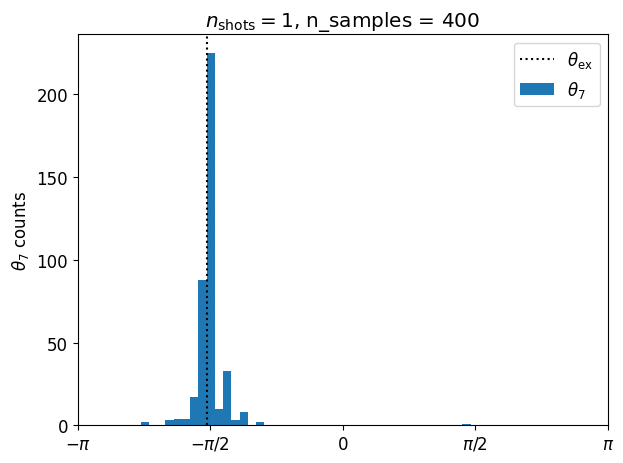
We see that for e.g. m=7, the estimated angle \(\theta_7\) is most of the time very close to the actual value, although there are a few cases where it lies far away.
Let us now vizualise the possible trajectories. In the figure below, we plot all the different trajectories of our samples. Each dot corresponds to a reached value, the color intensity signals probability:
dist1 = qpe.angular_distance(thetas1, theta_exact)
unique, count = np.unique(dist1, axis=0, return_counts=True)
cmax = count.max()
M = dist1.shape[1]

fig, ax = plt.subplots(layout="tight")
ax.plot(np.pi / 3 / 2 ** np.arange(M), "k--", label="$2^{-m}~\\pi/3$")
for u, c in zip(unique, count, strict=True):
    ax.plot(np.arange(M), u, "-", alpha=c / cmax, lw=2 * c / cmax, color="tab:blue")

for m in range(M):
    unique_m, count_m = np.unique(dist1[:, m], return_counts=True)
    cmax_m = count_m.max()
    for u, c in zip(unique_m, count_m, strict=True):
        ax.plot(m, u, "o", alpha=c / cmax_m, ms=10, color="tab:blue")

ax.set_yscale("log")
ax.legend(loc="lower left")
ax.set_xlabel("iteration $m$")
ax.set_ylabel("$d(\\theta_m, \\theta_{\\rm ex})$")
ax.set_title(f"$n_{{\\rm shots}} = 1$, {n_samples = }")
Text(0.5, 1.0, '$n_{\\rm shots} = 1$, n_samples = 400')
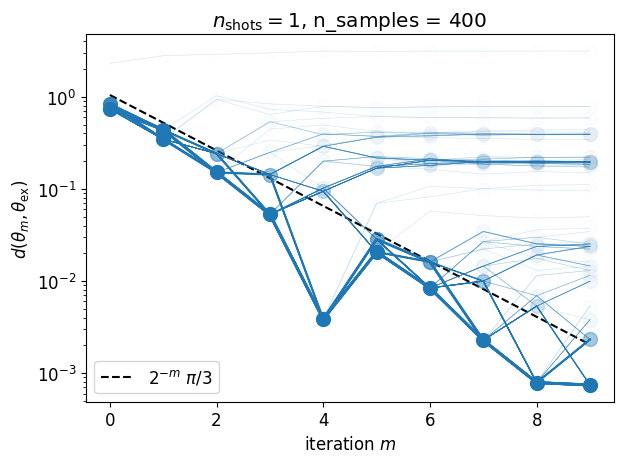
We see that it is at each step, there is a small but non zero possibility to make an error from which it is unlikely to recover. In such a case, theta_m converges to a value that is not \(\theta_{\rm ex}\). Since there is a fixed gap between different possibly reached values, taking the average over n_samples with fixed n_shots does not converge to the exact value \(\theta_{\rm ex}\). However, improving the sampling by adding more shots does improve the accuracy, as we can see when considering a higher number of shots:
rng = np.random.default_rng(42)
n_samples, M = thetas1.shape

thetas2 = np.zeros((n_samples, M))
thetas3 = np.zeros((n_samples, M))
for i in tqdm.tqdm(range(n_samples)):
    thetas2[i] = qpe.robust_phase_estimation(H, psi0, M, EXACT, 2, t0=t0, rng=rng)
    thetas3[i] = qpe.robust_phase_estimation(H, psi0, M, EXACT, 3, t0=t0, rng=rng)

mode2, success_prob2 = success_prob(thetas2)
mode3, success_prob3 = success_prob(thetas3)
colors = ("tab:orange", "tab:green")
fig, axes = plt.subplots(ncols=2, layout="tight", figsize=(12, 6), sharey=True)

for i, thetas in enumerate((thetas2, thetas3)):
    axes[i].plot(np.pi / 3 / 2 ** np.arange(M), "k--", label="$2^{-m}~\\pi/3$")
    dist = qpe.angular_distance(thetas, theta_exact)
    unique, count = np.unique(dist, axis=0, return_counts=True)
    cmax = count.max()
    for u, c in zip(unique, count, strict=True):
        axes[i].plot(
            np.arange(M), u, "-", alpha=c / cmax, lw=2 * c / cmax, color=colors[i]
        )

    for m in range(M):
        unique_m, count_m = np.unique(dist[:, m], return_counts=True)
        cmax_m = count_m.max()
        for u, c in zip(unique_m, count_m, strict=True):
            axes[i].plot(m, u, "o", alpha=c / cmax_m, ms=10, color=colors[i])

    axes[i].set_yscale("log")
    axes[i].set_xlabel("iteration $m$")
    axes[i].set_title(f"$n_{{\\rm shots}} = {i + 2}$, n_samples = {dist.shape[0]}")

axes[0].legend(loc="lower left")
axes[0].set_ylabel("$d(\\theta_m, \\theta_{\\rm ex})$");
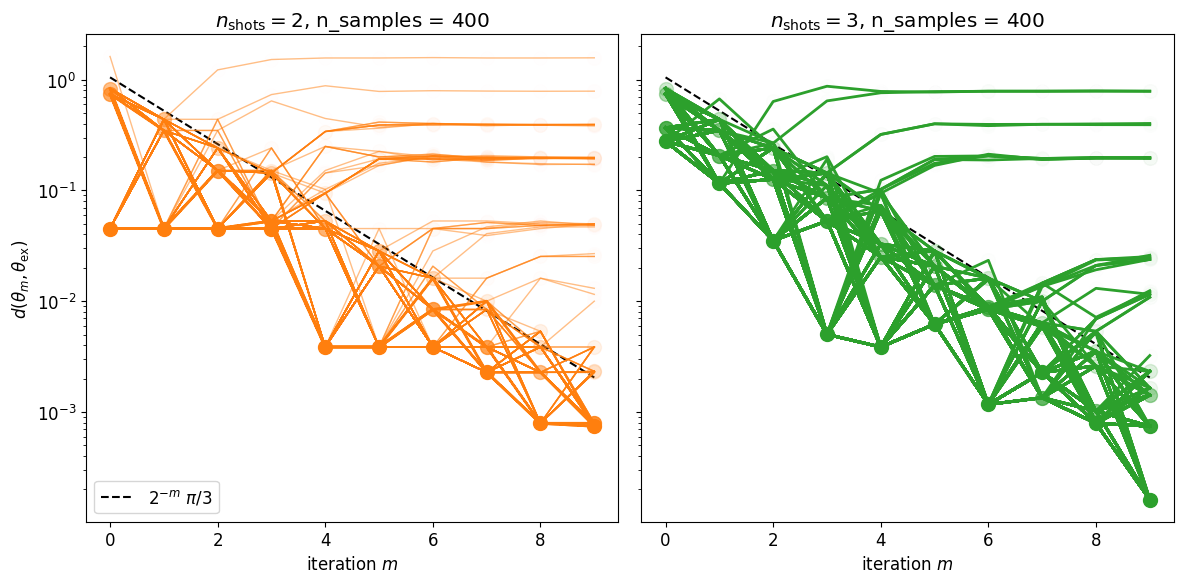
Let us look at the success probability, ie the probability for \(\theta_m\) to be within \(2^{-m}\pi/3\) angular distance from \(\theta_{\rm ex}\):
fig, ax = plt.subplots(layout="tight")
ax.plot(success_prob1, "-o", label=r"$n_{\rm shots} = 1$")
ax.plot(success_prob2, "-s", label=r"$n_{\rm shots} = 2$")
ax.plot(success_prob3, "-x", label=r"$n_{\rm shots} = 3$")
ax.set_ylim(0, 1.0)
ax.set_xlim(0, M - 1)
ax.set_xlabel("iteration $m$")
ax.set_ylabel("success rate at iteration $m$")
ax.legend(loc="lower left", title=f"Heisenberg chain\n{n_qubits = }")
ax.set_title(f"{n_samples = }");
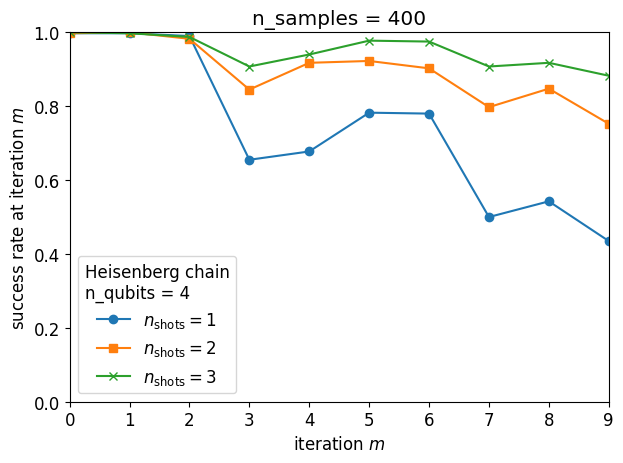
We see increasing n_shots significantly increases the probability of success. Fortunately, small values such as n_shots=2 already provide high probability to reach high precision. Finally, let us compare the most likely outcome for different n_shots:
fig, ax = plt.subplots(layout="tight")
ax.plot(np.pi / 3 / 2 ** np.arange(M), "k--", label="$2^{-m}~\\pi/3$")
ax.plot(qpe.angular_distance(mode1, theta_exact), "-o", label=r"$n_{\rm shots} = 1$")
ax.plot(qpe.angular_distance(mode2, theta_exact), "-s", label=r"$n_{\rm shots} = 2$")
ax.plot(qpe.angular_distance(mode3, theta_exact), "-v", label=r"$n_{\rm shots} = 3$")

ax.set_yscale("log")
ax.legend(loc="lower left", title=f"Heisenberg chain\n{n_qubits = }")
ax.set_xlabel("iteration $m$")
ax.set_ylabel("$d(\\theta_m, \\theta_{\\rm ex})$")
ax.set_title(f"{n_samples = }, most likely outcome");
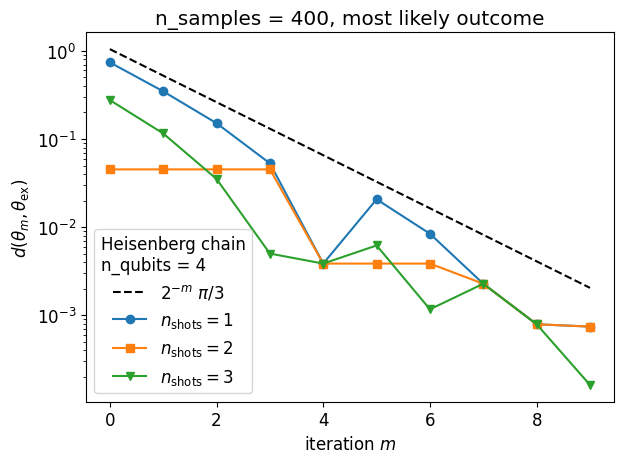
Here, we see that adding more shots increases the probability of success (=probability of converging to \(\theta_{\rm ex}\) as m grows) and reduces the chance to have an error at a given stage m, but also increases the accuracy of the most likely case. However, the simulation cost grows linearly with n_shots, as on a quantum computer each shot corresponds to a different run of the quantum algorithm.
To conclude this section, the robust phase estimation works surprisingly well even for small values of n_shots, although errors are still possible. Let us mention that it is possible to write consistency checks in order to detect an error at step m. We will not discuss this here and refer to Phys. Rev. A 103, 042609 for more details.
7.3. Heisenberg Scaling
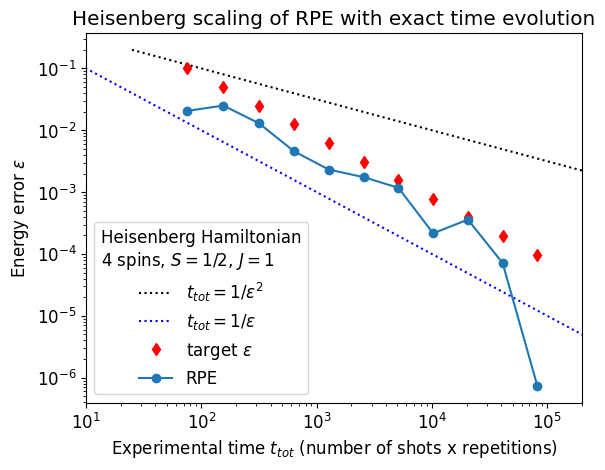
The experimental time is proportional to \(n_{\rm shots} \cdot \sum_{m=0}^{M-1} 2^m\), i.e. it scales like \(2^M\). With \(M = \lceil \log_2 \varepsilon^{-1} \rceil\) iterations, the RPE algorithm reaches a precision of order \(\varepsilon\) (the guaranteed bound is \(2^{-(M-1)}\pi/3 \simeq 2\varepsilon\)). Hence it achieves Heisenberg scaling: reaching a precision \(\varepsilon\) in time \(\mathcal{O}(2^M) = \mathcal{O}(1/\varepsilon)\).
Let us illustrate that below: we run the RPE algorithm for various \(\varepsilon\) and plot experimental time versus energy error. Here we use exact time evolution for simplicity: in this case the experimental time is exactly \(n_{\rm shots} \cdot \sum_{m=0}^{M-1} 2^m\).
epsilon_values = 0.1 / 2 ** np.arange(11)
n_shots = 5

cost_values = np.empty_like(epsilon_values)
final_thetas = np.empty_like(epsilon_values)
rng = np.random.default_rng(42)
for i, epsilon in enumerate(epsilon_values):
    M = int(np.ceil(np.log2(1 / epsilon)))
    cost_values[i] = sum([n_shots * 2**m for m in range(M)])
    thetas_iter = qpe.robust_phase_estimation(
        H, psi0, M, EXACT, n_shots, t0=t0, rng=rng
    )
    final_thetas[i] = thetas_iter[-1]
xfit = np.array([0.2, 0.1 / 2**15])
plt.loglog(xfit**-2, xfit, "k:", label=r"$t_{tot}=1/\epsilon^2$")
plt.loglog(xfit**-1, xfit, "b:", label=r"$t_{tot}=1/\epsilon$")
plt.loglog(cost_values, epsilon_values, "rd", label=r"target $\epsilon$")
plt.loglog(
    cost_values,
    qpe.angular_distance(final_thetas, theta_exact) / t0,
    "-o",
    label="RPE",
)

plt.xlabel("Experimental time $t_{tot}$ (number of shots x repetitions)")
plt.ylabel(r"Energy error $\epsilon$")
plt.title("Heisenberg scaling of RPE with exact time evolution")
plt.xlim(10, 2e5)
plt.legend(title="Heisenberg Hamiltonian\n4 spins, $S=1/2$, $J=1$");
7.4. Quantum Chemistry Example: Diatomic Hydrogen
Let us now consider a molecule: we take \(H_2\) in the minimal atomic orbital basis STO-3G. The Hamiltonian in qubit form is obtained via a Jordan-Wigner transformation. Unlike the previous spin Hamiltonian, the molecular Hamiltonian is non-local: it couples distant qubits.
mol = gto.M(atom=[("H", (0.0, 0.0, 0.0)), ("H", (0.0, 0.0, 0.735))], basis="STO-3G")

H_H2 = chemistry_hamiltonian(
    mol, hf_mode="rhf", encoding="original", do_fci=True, do_ccsd=False
)
E0_H2, psi0_H2 = do_dmrg(H_H2)
print(f"E_DMRG : {E0_H2 + H_H2.e_const:.10f}")
converged SCF energy = -1.116998996754
nOrb   : 2
nElec  : 2
E_HF   : -1.1169989968
E_CI : -1.1373060358
E_DMRG : -1.1373060358
7.4.1. Exact Time Evolution
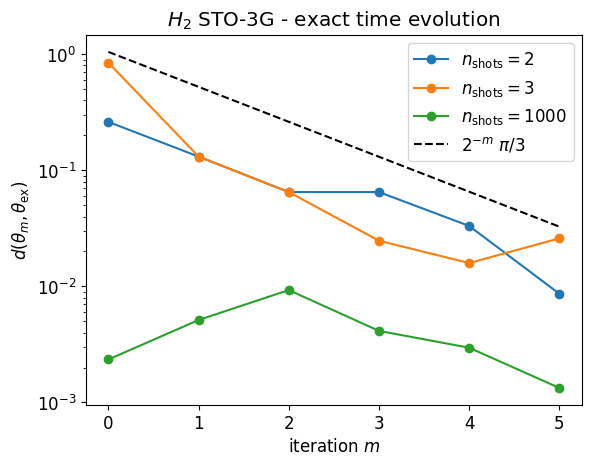
The system is small enough for exact exponentiation of the Hamiltonian matrix, and exact time evolution.
epsilon = 0.02
M = int(np.ceil(np.log2(1 / epsilon)))
shot_counts_H2 = [2, 3, 1000]
t0 = 1.0
theta_exact_H2 = E0_H2 * t0

# results are seed dependent when n_shot is small
# Here we pick a seed representative of the most common case.
rng = np.random.default_rng(2)
for n_shots in shot_counts_H2:
    theta_values = qpe.robust_phase_estimation(
        H_H2, psi0_H2, M, EXACT, n_shots, t0=t0, rng=rng
    )
    distances = qpe.angular_distance(theta_values, theta_exact_H2)
    plt.semilogy(distances, "-o", label=f"$n_{{\\rm shots}}={n_shots}$")

plt.semilogy(np.pi / 3 / 2 ** np.arange(M), "k--", label="$2^{-m}~\\pi/3$")
plt.legend()
plt.title(r"$H_2$ STO-3G - exact time evolution")
plt.xlabel("iteration $m$")
plt.ylabel("$d(\\theta_m, \\theta_{\\rm ex})$");
7.4.2. Trotterized Time Evolution
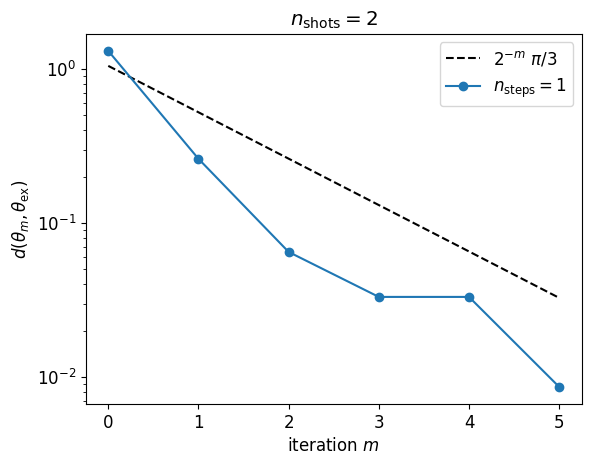
We now apply the same algorithm but replace the exact time evolution operator by a second order Trotter approximation.
The n_steps argument in the robust_phase_estimation function sets the number of Trotter steps for \(m=0\). The number of steps is multiplied by \(2\) at each iteration to keep the Trotter timestep constant.
The computation will now take longer since the number of gates for the time evolution grows like \(2^m\). Here for simplicity we choose a single seed which happens to be representative of the most likely case. The following run will take a minute.
%%time
n_shots = 2
n_steps = 1

rng = np.random.default_rng(42)
thetas_trotter_H2 = qpe.robust_phase_estimation(
    H_H2, psi0_H2, M, n_steps, n_shots, t0=t0, trotter_order=2, verbosity=1, rng=rng
)
distances_trotter_H2 = qpe.angular_distance(thetas_trotter_H2, theta_exact_H2)
m 	 phi_m  	 theta_m 	 time (s)
0 	 -2.3562 	 -2.3562 	 0.7
1 -1.5708 -0.7854 2.0
2 2.3562 -0.9817 4.5
3 -2.3562 -1.0799 9.4
4 1.5708 -1.0799 19.3
5 	 -2.3562 	 -1.0554 	 39.0
CPU times: user 39 s, sys: 324 ms, total: 39.3 s
Wall time: 39 s
Since the number of qubits is small, we still reach the desired precision despite the small number of Trotter steps.
plt.semilogy(np.pi / 3 / 2 ** np.arange(M), "k--", label="$2^{-m}~\\pi/3$")
plt.semilogy(distances_trotter_H2, "-o", label=f"$n_{{\\rm steps}}={n_steps}$")
plt.legend()
plt.title(f"$n_{{\\rm shots}}={n_shots}$")
plt.xlabel("iteration $m$")
plt.ylabel(r"$d(\theta_m, \theta_{\rm ex})$");
7.4.3. Chemical Accuracy?
The standard for chemical accuracy is \(\varepsilon = 10^{-3}\) Ha. Hartrees are the default unit in pyscf. We can directly compute the number of iterations required for chemical accuracy:
epsilon = 0.001
M = int(np.ceil(np.log2(1 / epsilon)))
print(f"Chemical accuracy eps={epsilon} requires M={M} iterations")
Chemical accuracy eps=0.001 requires M=10 iterations
Reaching chemical accuracy requires at least ten iterations, and a sufficient number of shots and Trotter steps. If you want to go further, you can first estimate the runtime for \(M=10\) and a given number of shots and Trotter steps, then with some patience try to run the simulation.