3. Textbook QPE
We introduce the Quantum Phase Estimation algorithm and show how to compute the ground state energy of a Hamiltonian \(H\). We consider a small system where the exponentiation of the Hamiltonian can be performed exactly, yielding the exact time evolution operator \(U(t) = \exp(-iHt)\).
First, let us briefly introduce the algorithm. For a more detailed introduction, we refer the reader to the famous book by Michael A. Nielsen and Isaac L. Chuang on Quantum Computation and Quantum Information, or to the Quantum Phase Estimation algorithm Wikipedia page.
Consider a unitary operator \(U\) and an eigenstate \(\ket{u}\) of \(U\): \(U \ket{u} = e^{i2\pi \theta} \ket{u}\). We want to measure \(\theta\) with \(m\)-bit precision.
The QPE circuit contains two registers: a physical register with \(n\) qubits and a phase register with \(m\) qubits.
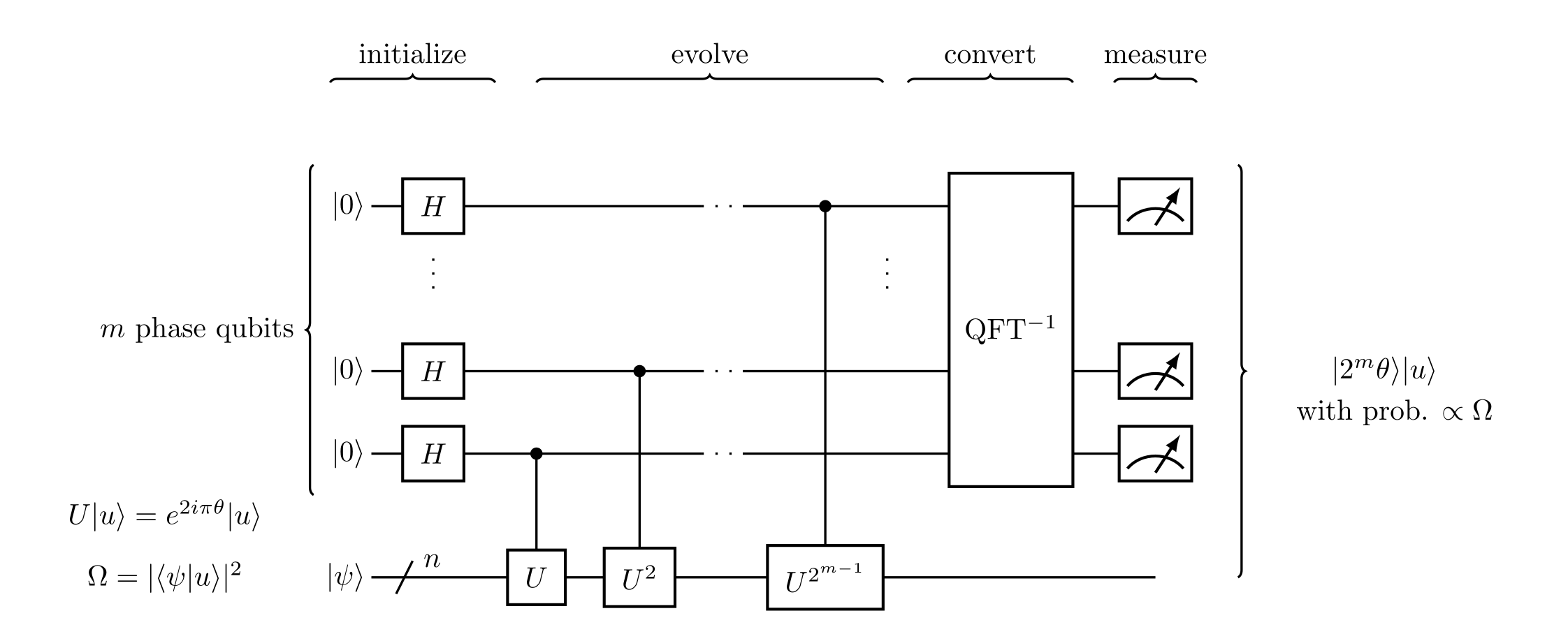
The physical register starts in state \(\ket{\psi}\), where \(\ket{\psi}\) is an estimate of \(\ket{u}\) with fidelity \(\Omega = \vert \langle \psi \vert u \rangle \vert^2\).
The phase register is initially in state \(\ket{0}\).
The circuit starts with a Hadamard wall to put the phase register into a superposition state.
Then we encode the phase into the phase register via a sequence of controlled powers of \(U\):
For \(k=0,1,\ldots,m-1\), \(U^{2^k}\) is applied to the physical register, conditioned on the \(k\)-th phase qubit.
Finally to decode the phase, we apply the inverse Quantum Fourier Transform (QFT) on the phase register.
We measure the phase register and find an \(m\)-bit approximation to \(\theta\) with probability \(\propto \Omega\) (at least \(4\Omega/\pi^2\), see below).
After the measurement, the physical register has been projected onto \(\ket{u}\).
The notebook is organised as follows: In the first section, we illustrate and detail the different parts of the algorithm on a small 1D Heisenberg Hamiltonian. In the second section, we study the precision and success probability of the algorithm in more detail. Finally, in the third section we focus on the influence of the initial overlap \(\Omega\).
import time

import matplotlib.pyplot as plt
import numpy as np
import scipy.sparse.linalg as sla
from IPython.display import display
from quimb.tensor import MatrixProductState
from tqdm import notebook as tqdm

import qpe_toolbox.estimation as qpe
from qpe_toolbox import EXACT
from qpe_toolbox.circuit import make_circ
from qpe_toolbox.hamiltonian import do_dmrg, heisenberg_hamiltonian
plt.rcParams.update({"font.size": 12})
3.1. Quantum Phase Estimation basics
First let us define a simple Hamiltonian which we can
diagonalize exactly
encode as a quantum circuit
Consider the nearest-neighbor Heisenberg Hamiltonian on a 1D chain with open boundary conditions
where \(\vec{S}_k = \vec{\sigma}_k /2 \;\) are the spin-1/2 generators of SU(2) acting on site \(k\), with \(\vec{\sigma} = (\sigma^x, \sigma^y, \sigma^z)\) the Pauli matrices.
We take \(J=1\) in the following, such that all energies are expressed in units of \(J\).
3.1.1. Spin Hamiltonian construction
Let us define the Hamiltonian and perform exact diagonalization
n_qubits = 2
h_spin = heisenberg_hamiltonian(n_qubits)

# Get matrix
hamilt_matrix = h_spin.to_dense()

# Diagonalize hamiltonian
eigvals, eigvecs = np.linalg.eigh(hamilt_matrix)
# Ground state
E0 = eigvals[0]
psi0 = eigvecs[:, 0]
print(f"E_ED : {E0:.4f}")
E_ED : -0.7500
# Ground state MPS
E0_dmrg, psi0_mps = do_dmrg(h_spin)
print(f"E_DMRG : {E0_dmrg:.4f}")
E_DMRG : -0.7500
F = abs(psi0_mps.H @ MatrixProductState.from_dense(psi0)) ** 2
print(f"1 - |<psi_DMRG|psi_ED>|^2 = {abs(1 - F):.4g}")
1 - |<psi_DMRG|psi_ED>|^2 = 4.441e-16
3.1.2. Circuit initialization
We now initialize the QPE circuit with a physical register containing \(|\psi_0\rangle\), and a phase register with \(m=4\) phase qubits; then measure the energy from the circuit
n_phase_bits = 4

psi_target = psi0_mps
initial_circ = make_circ(n_phase_bits, psi_target)

data_reg = list(range(n_phase_bits, n_phase_bits + n_qubits))
print(
    f"measure H = {initial_circ.local_expectation(hamilt_matrix, where=data_reg):.4f}"
)
measure H = -0.7500
3.1.3. First stage of Quantum Phase Estimation
See, e.g., Nielsen and Chuang.
First, initialize the phase register with a “Hadamard wall”
Then build the operator \(U = \exp(-i H t)\) for a given evolution time \(t\) and apply a sequence of gates ctrl-\(U^{2^k}\) on the physical register conditioned on the \(k\)-th phase qubit.
Since \(|\psi_0 \rangle\) is an eigenstate of \(H\), we have \(U |\psi_0 \rangle = \exp(i2\pi \theta) |\psi_0 \rangle\) with \(0 \leq \theta \leq 1\) (\(U\) is unitary because \(H\) is Hermitian).
The state of the phase register is then
(the physical register stays in the state \(|\psi_0\rangle\))
E_target = E0 + 0.2
size_interval = 2

Emax = E_target + size_interval / 2
evolution_time = 2 * np.pi / size_interval
global_phase = Emax * evolution_time

traces, circ = qpe.qpe_first_stage(
    h_spin, initial_circ, evolution_time, EXACT, global_phase
)

circ.psi.retag_({f"I{i}": f"I_phase{i}" for i in range(n_phase_bits)})
phase_reg = list(range(n_phase_bits))
psi = circ.psi.copy()
display(psi)
MatrixProductState(tensors=22, indices=31, L=6, max_bond=2)
Tensor(shape=(2), inds=[_e6ad47AAAAQ], tags={I0, PSI0}),
backend=numpy, dtype=float64, data=array([1., 0.])Tensor(shape=(2), inds=[_e6ad47AAAAR], tags={I1, PSI0}),
backend=numpy, dtype=float64, data=array([1., 0.])Tensor(shape=(2), inds=[_e6ad47AAAAS], tags={I2, PSI0}),
backend=numpy, dtype=float64, data=array([1., 0.])Tensor(shape=(2), inds=[_e6ad47AAAAT], tags={I3, PSI0}),
backend=numpy, dtype=float64, data=array([1., 0.])Tensor(shape=(2, 2), inds=[_e6ad47AAAAF, _e6ad47AAAAd], tags={I4, PSI0}),
backend=numpy, dtype=complex128, data=array([[0.+0.j, 1.+0.j], [1.+0.j, 0.+0.j]])Tensor(shape=(2, 2), inds=[_e6ad47AAAAF, _e6ad47AAAAe], tags={I5, PSI0}),
backend=numpy, dtype=complex128, data=array([[-0.70710678+0.j, -0. +0.j], [ 0. +0.j, 0.70710678+0.j]])Tensor(shape=(2, 2), inds=[_e6ad47AAAAU, _e6ad47AAAAQ], tags={GATE_0, ROUND_0, H, I0}),
backend=numpy, dtype=complex128, data=array([[ 0.70710678+0.j, 0.70710678+0.j], [ 0.70710678+0.j, -0.70710678+0.j]])Tensor(shape=(2, 2), inds=[_e6ad47AAAAf, _e6ad47AAAAR], tags={GATE_1, ROUND_0, H, I1}),
backend=numpy, dtype=complex128, data=array([[ 0.70710678+0.j, 0.70710678+0.j], [ 0.70710678+0.j, -0.70710678+0.j]])Tensor(shape=(2, 2), inds=[_e6ad47AAAAq, _e6ad47AAAAS], tags={GATE_2, ROUND_0, H, I2}),
backend=numpy, dtype=complex128, data=array([[ 0.70710678+0.j, 0.70710678+0.j], [ 0.70710678+0.j, -0.70710678+0.j]])Tensor(shape=(2, 2), inds=[_e6ad47AAABB, _e6ad47AAAAT], tags={GATE_3, ROUND_0, H, I3}),
backend=numpy, dtype=complex128, data=array([[ 0.70710678+0.j, 0.70710678+0.j], [ 0.70710678+0.j, -0.70710678+0.j]])Tensor(shape=(2, 2), inds=[_e6ad47AAAAc, _e6ad47AAAAU], tags={GATE_4, ROUND_1, PHASE, I0}),
backend=numpy, dtype=complex128, data=array([[1. +0.j , 0. +0.j ], [0. +0.j , 0.15643447+0.98768834j]])Tensor(shape=(2, 2, 2), inds=[_e6ad47AAAAb, k0, _e6ad47AAAAc], tags={I0, GATE_5}),
backend=numpy, dtype=complex128, data=array([[[1.+0.j, 0.+0.j], [0.+0.j, 1.+0.j]], [[0.+0.j, 0.+0.j], [0.+0.j, 1.+0.j]]])Tensor(shape=(2, 2, 2, 2, 2), inds=[_e6ad47AAAAb, _e6ad47AAAAo, _e6ad47AAAAp, _e6ad47AAAAd, _e6ad47AAAAe], tags={I4, I5, GATE_5}),
backend=numpy, dtype=complex128, data=array([[[[[ 1. +0.00000000e+00j, 0. +0.00000000e+00j], [ 0. +0.00000000e+00j, 0. +0.00000000e+00j]], [[ 0. +0.00000000e+00j, 1. +0.00000000e+00j], [ 0. +0.00000000e+00j, 0. +0.00000000e+00j]]], [[[ 0. +0.00000000e+00j, 0. +0.00000000e+00j], [ 1. +0.00000000e+00j, 0. +0.00000000e+00j]], [[ 0. +0.00000000e+00j, 0. +0.00000000e+00j], [ 0. +0.00000000e+00j, 1. +0.00000000e+00j]]]], [[[[-0.29289322-7.07106781e-01j, 0. +0.00000000e+00j], [ 0. +0.00000000e+00j, 0. +0.00000000e+00j]], [[ 0. +0.00000000e+00j, -1. +7.90350209e-17j], [ 0.70710678-7.07106781e-01j, 0. +0.00000000e+00j]]], [[[ 0. +0.00000000e+00j, 0.70710678-7.07106781e-01j], [-1. +0.00000000e+00j, 0. +0.00000000e+00j]], [[ 0. +0.00000000e+00j, 0. +0.00000000e+00j], [ 0. +0.00000000e+00j, -0.29289322-7.07106781e-01j]]]]])Tensor(shape=(2, 2), inds=[_e6ad47AAAAn, _e6ad47AAAAf], tags={GATE_6, ROUND_2, PHASE, I1}),
backend=numpy, dtype=complex128, data=array([[ 1. +0.j , 0. +0.j ], [ 0. +0.j , -0.95105652+0.30901699j]])Tensor(shape=(2, 2, 2), inds=[_e6ad47AAAAm, k1, _e6ad47AAAAn], tags={I1, GATE_7}),
backend=numpy, dtype=complex128, data=array([[[1.+0.j, 0.+0.j], [0.+0.j, 1.+0.j]], [[0.+0.j, 0.+0.j], [0.+0.j, 1.+0.j]]])Tensor(shape=(2, 2, 2, 2, 2), inds=[_e6ad47AAAAm, _e6ad47AAAAz, _e6ad47AAABA, _e6ad47AAAAo, _e6ad47AAAAp], tags={I4, I5, GATE_7}),
backend=numpy, dtype=complex128, data=array([[[[[ 1.00000000e+00+0.0000000e+00j, 0.00000000e+00+0.0000000e+00j], [ 0.00000000e+00+0.0000000e+00j, 0.00000000e+00+0.0000000e+00j]], [[ 0.00000000e+00+0.0000000e+00j, 1.00000000e+00+0.0000000e+00j], [ 0.00000000e+00+0.0000000e+00j, 0.00000000e+00+0.0000000e+00j]]], [[[ 0.00000000e+00+0.0000000e+00j, 0.00000000e+00+0.0000000e+00j], [ 1.00000000e+00+0.0000000e+00j, 0.00000000e+00+0.0000000e+00j]], [[ 0.00000000e+00+0.0000000e+00j, 0.00000000e+00+0.0000000e+00j], [ 0.00000000e+00+0.0000000e+00j, 1.00000000e+00+0.0000000e+00j]]]], [[[[-1.00000000e+00-1.0000000e+00j, 0.00000000e+00+0.0000000e+00j], [ 0.00000000e+00+0.0000000e+00j, 0.00000000e+00+0.0000000e+00j]], [[ 0.00000000e+00+0.0000000e+00j, -1.00000000e+00-1.0000000e+00j], [ 3.19244094e-17+7.9847989e-17j, 0.00000000e+00+0.0000000e+00j]]], [[[ 0.00000000e+00+0.0000000e+00j, 3.19244094e-17+7.9847989e-17j], [-1.00000000e+00-1.0000000e+00j, 0.00000000e+00+0.0000000e+00j]], [[ 0.00000000e+00+0.0000000e+00j, 0.00000000e+00+0.0000000e+00j], [ 0.00000000e+00+0.0000000e+00j, -1.00000000e+00-1.0000000e+00j]]]]])Tensor(shape=(2, 2), inds=[_e6ad47AAAAy, _e6ad47AAAAq], tags={GATE_8, ROUND_3, PHASE, I2}),
backend=numpy, dtype=complex128, data=array([[1. +0.j , 0. +0.j ], [0. +0.j , 0.80901699-0.58778525j]])Tensor(shape=(2, 2, 2), inds=[_e6ad47AAAAx, k2, _e6ad47AAAAy], tags={I2, GATE_9}),
backend=numpy, dtype=complex128, data=array([[[1.+0.j, 0.+0.j], [0.+0.j, 1.+0.j]], [[0.+0.j, 0.+0.j], [0.+0.j, 1.+0.j]]])Tensor(shape=(2, 2, 2, 2, 2), inds=[_e6ad47AAAAx, _e6ad47AAABK, _e6ad47AAABL, _e6ad47AAAAz, _e6ad47AAABA], tags={I4, I5, GATE_9}),
backend=numpy, dtype=complex128, data=array([[[[[ 1.00000000e+00+0.00000000e+00j, 0.00000000e+00+0.00000000e+00j], [ 0.00000000e+00+0.00000000e+00j, 0.00000000e+00+0.00000000e+00j]], [[ 0.00000000e+00+0.00000000e+00j, 1.00000000e+00+0.00000000e+00j], [ 0.00000000e+00+0.00000000e+00j, 0.00000000e+00+0.00000000e+00j]]], [[[ 0.00000000e+00+0.00000000e+00j, 0.00000000e+00+0.00000000e+00j], [ 1.00000000e+00+0.00000000e+00j, 0.00000000e+00+0.00000000e+00j]], [[ 0.00000000e+00+0.00000000e+00j, 0.00000000e+00+0.00000000e+00j], [ 0.00000000e+00+0.00000000e+00j, 1.00000000e+00+0.00000000e+00j]]]], [[[[-2.00000000e+00-6.66133815e-16j, 0.00000000e+00+0.00000000e+00j], [ 0.00000000e+00+0.00000000e+00j, 0.00000000e+00+0.00000000e+00j]], [[ 0.00000000e+00+0.00000000e+00j, -2.00000000e+00+2.22044605e-16j], [ 1.59695978e-16-6.38488188e-17j, 0.00000000e+00+0.00000000e+00j]]], [[[ 0.00000000e+00+0.00000000e+00j, 1.59695978e-16-6.38488188e-17j], [-2.00000000e+00+2.22044605e-16j, 0.00000000e+00+0.00000000e+00j]], [[ 0.00000000e+00+0.00000000e+00j, 0.00000000e+00+0.00000000e+00j], [ 0.00000000e+00+0.00000000e+00j, -2.00000000e+00-6.66133815e-16j]]]]])Tensor(shape=(2, 2), inds=[_e6ad47AAABJ, _e6ad47AAABB], tags={GATE_10, ROUND_4, PHASE, I3}),
backend=numpy, dtype=complex128, data=array([[1. +0.j , 0. +0.j ], [0. +0.j , 0.30901699-0.95105652j]])Tensor(shape=(2, 2, 2), inds=[_e6ad47AAABI, k3, _e6ad47AAABJ], tags={I3, GATE_11}),
backend=numpy, dtype=complex128, data=array([[[1.+0.j, 0.+0.j], [0.+0.j, 1.+0.j]], [[0.+0.j, 0.+0.j], [0.+0.j, 1.+0.j]]])Tensor(shape=(2, 2, 2, 2, 2), inds=[_e6ad47AAABI, k4, k5, _e6ad47AAABK, _e6ad47AAABL], tags={I4, I5, GATE_11}),
backend=numpy, dtype=complex128, data=array([[[[[ 1.00000000e+00+0.00000000e+00j, 0.00000000e+00+0.00000000e+00j], [ 0.00000000e+00+0.00000000e+00j, 0.00000000e+00+0.00000000e+00j]], [[ 0.00000000e+00+0.00000000e+00j, 1.00000000e+00+0.00000000e+00j], [ 0.00000000e+00+0.00000000e+00j, 0.00000000e+00+0.00000000e+00j]]], [[[ 0.00000000e+00+0.00000000e+00j, 0.00000000e+00+0.00000000e+00j], [ 1.00000000e+00+0.00000000e+00j, 0.00000000e+00+0.00000000e+00j]], [[ 0.00000000e+00+0.00000000e+00j, 0.00000000e+00+0.00000000e+00j], [ 0.00000000e+00+0.00000000e+00j, 1.00000000e+00+0.00000000e+00j]]]], [[[[-8.88178420e-16+1.33226763e-15j, 0.00000000e+00+0.00000000e+00j], [ 0.00000000e+00+0.00000000e+00j, 0.00000000e+00+0.00000000e+00j]], [[ 0.00000000e+00+0.00000000e+00j, -4.44089210e-16-4.44089210e-16j], [-3.19391956e-16+1.27697638e-16j, 0.00000000e+00+0.00000000e+00j]]], [[[ 0.00000000e+00+0.00000000e+00j, -3.19391956e-16+1.27697638e-16j], [-4.44089210e-16-4.44089210e-16j, 0.00000000e+00+0.00000000e+00j]], [[ 0.00000000e+00+0.00000000e+00j, 0.00000000e+00+0.00000000e+00j], [ 0.00000000e+00+0.00000000e+00j, -8.88178420e-16+1.33226763e-15j]]]]])# Visualize the circuit as a tensor network
### represent controlled-U gates as a single node
for i in [n_phase_bits + 1 + 2 * j for j in range(4)]:
psi.contract_(tags={f"GATE_{i}"})
psi.draw(
figsize=(12, 8),
show_tags=True,
color={"PSI0", "CU"},
edge_scale=1,
layout="kamada_kawai",
edge_color=True,
)
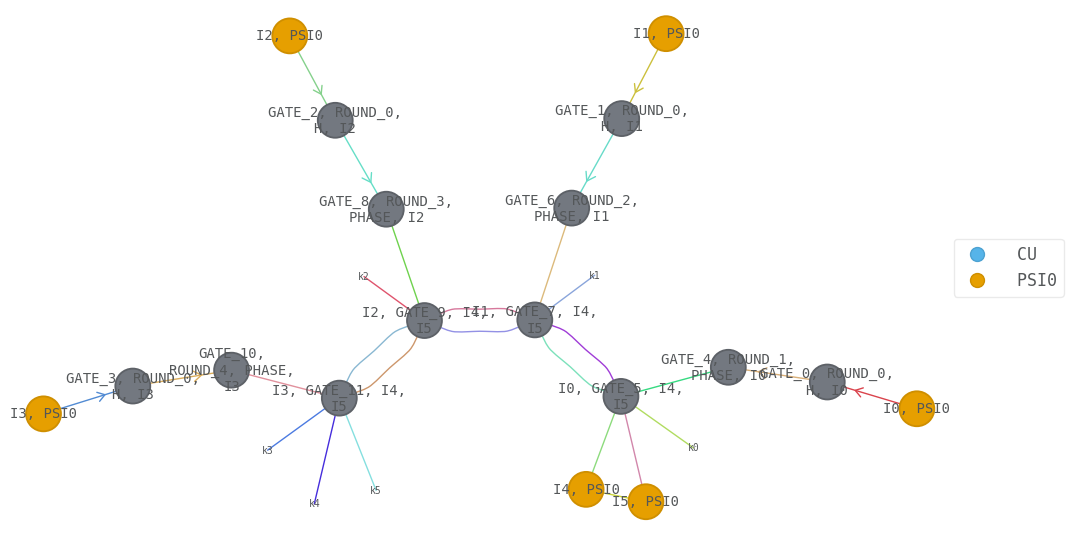
If we suppose that \(\theta = 0.\theta_1...\theta_m\), i.e. that \(\theta\) can be expressed exactly in \(m\) bits, then the previous expression for the state in the phase register corresponds exactly to the QFT of the product state \(|\theta_1 ... \theta_m \rangle\). Therefore, applying the inverse QFT and measuring in the computational basis gives \(\theta\) exactly. When this is not the case, the most probable output gives the closest \(m\)-bit approximation to \(\theta\).
3.1.4. Second stage: Inverse Quantum Fourier Transform
The state of the phase register after the inverse QFT reads:
Now let us introduce the following expression for \(\theta\):
where \(a\) is an integer between \(0\) and \(2^m-1\) and \(\delta \in [-1/2^{m+1}, 1/2^{m+1}]\). \(a/2^m\) is the best \(m\)-bit approximation to \(\theta\), and \(\delta\) is the corresponding deviation.
The state in the phase register then reads
3.1.5. Measurement and outcome
At the last step of the QPE algorithm, we sample from the phase register. We measure \(\ket{a} = \ket{[2^m \theta]}\) with probability
We then see that when \(\delta=0\), then \(\theta = a / 2^m\) and \(P(a) = 1\); the outcome \(\ket{a}\) is deterministic in this case.
In the general case, \(\ket{a}\) is the most probable output with probability \(P(a) < 1\).
Let us plot this probability \(P(a)\) as a function of \(\delta\), for a given \(m\).
def prob_measure_a(delta, m):
    return (
        abs(1 / 2**m * sum([np.exp(2j * np.pi * delta * q) for q in range(2**m)])) ** 2
    )


m = 4
delta = np.linspace(-1 / 2 ** (m + 1), 1 / 2 ** (m + 1), 100)
plt.plot(delta, prob_measure_a(delta, m))
plt.title(r"Probability of measuring $|a\rangle$ when $\theta = a / 2^m + \delta$")
plt.xlabel(r"$\delta$")
plt.ylabel(r"$P(a)$");
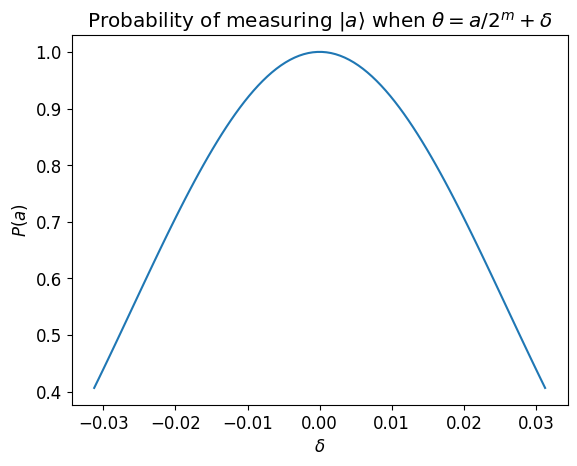
We observe that \(P(a)\) is minimal when the distance between \(\theta\) and its best approximation \(a/2^m\) is maximal, i.e. for \(\delta = \pm 1/2^{m+1}\).
As shown here, there is a lower bound for the outcome probability \(P(a)\) when \(\delta \neq 0\):
Below, we visualize the minimal probability \(P(a)\) for \(\delta = 1/2^{m+1}\) as a function of \(m\).
def min_prob_a(m):
    return prob_measure_a(1 / 2 ** (m + 1), m)


ms = np.arange(1, 12)
plt.plot(ms, [min_prob_a(m) for m in ms])
plt.axhline(4 / np.pi**2, color="k", linestyle=":")
plt.title(r"Probability of measuring $|a\rangle$ when $\theta = a / 2^m + 1/2^{m+1}$")
plt.xlabel(r"$m$ phase qubits")
plt.yticks([4 / np.pi**2, 0.45, 0.5], [r"$4/\pi^2$", "$0.45$", "$0.5$"])
plt.ylabel(r"$P(a)$");
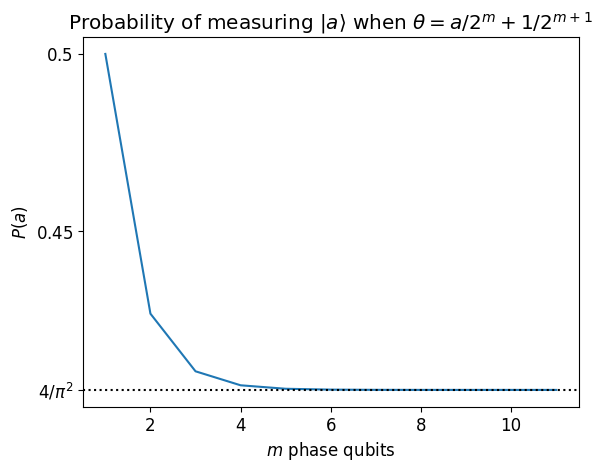
Thus with \(m\) phase qubits, we obtain an estimate of \(\theta\) with error \(\varepsilon_\theta = 1/2^m\), with probability exceeding \(40\%\). As we will see below, adding extra qubits will increase the probability of reaching the same precision.
Note that the error and depth of the circuit are independent of the number of “physical” qubits in the physical register \(n\), i.e. independent of the size of the physical system.
3.1.6. Evolution time and global phase
\(|\psi_0 \rangle\) is an eigenstate of \(U\) with eigenvalue \(\exp(i 2\pi \theta)\) and an eigenstate of \(H\) with eigenvalue \(E_0\).
Therefore \(\exp(i2\pi\theta ) = \exp( - i E t)\); this implies
Following the approach of the myQLM implementation of QPE, we can fix a “gauge choice” for \(\theta\) by introducing a global phase \(\phi\) in \(U\), setting \(U = \exp( - i H t + i \phi)\) and choosing the evolution time \(t\) such that we exactly have
If we know some approximation \(E_{\rm target}\) of the exact energy \(E_0\) up to an error \(\Delta\), then by setting
we have
where \(E_{\rm max/min} = E_{\rm target} \pm \Delta/2\).
Useful expression
The correspondence between the QPE output \(\theta\) and the energy \(E\) for a given set of parameters \(E_{\rm target}\) and \(\Delta\) is
From the previous equation, if we measure \(\theta\) with \(m\) bits of precision, the energy error is at most \(\Delta / 2^m\).
This bound is tight only in the worst case. On the other hand, if \(\theta\) has an exact \(m\)-bit expression, QPE returns \(E\) exactly for any number of phase qubits \(m' \geq m\).
When the initial guess is exact \(E = E_{\rm target}\), the QPE output is \(\theta = 1/2\). This case is very unlikely, since we precisely want to know \(E\).
3.2. Precision of exact QPE
Throughout this section, we assume that the physical register is initialized in the ground state \(\ket{\psi_0}\) and study the precision of the QPE estimate for \(E_0\).
3.2.1. Precision for a fixed target energy
In this example we start with a target energy off by 0.2: \(E_{\rm target} = E_0 + 0.2\). Let us recall that our energy scale has been fixed by defining our Hamiltonian (using \(J = 1\) in this example). With a search interval \(\Delta=2\), recovering \(E_0\) amounts to measuring
To measure \(\theta\) with an error less than \(10^{-2}\) we require 5 phase qubits, since
E_target = E0 + 0.2
size_interval = 2

print(f"exact theta = {(E_target + size_interval / 2 - E0) / size_interval:.6g}")

n_phase_bits = 5
print(
    f"Precision on theta = {1 / 2**n_phase_bits}, precision on energy = {1 / 2**n_phase_bits * size_interval}\n"
)

circ = make_circ(n_phase_bits=n_phase_bits, psi_mps=psi0_mps)
traces, energy = qpe.qpe_energy(
    h_spin, circ, EXACT, E_target, size_interval, verbosity=1
)

print("\nBest guess =", np.real(energy))
print("exact energy =", np.real(E0))
print("theoretical error bound =", size_interval / 2**n_phase_bits)

assert abs(E0 - energy) < size_interval / 2**n_phase_bits
exact theta = 0.6
Precision on theta = 0.03125, precision on energy = 0.0625
10011 |19> 0.59375 0.8753
10100 |20> 0.625 0.0548
10010 |18> 0.5625 0.0244
10101 |21> 0.65625 0.0109
10001 |17> 0.53125 0.0073
Best guess = -0.7375
exact energy = -0.75
theoretical error bound = 0.0625
Check that the second-best guess is also within an error \(\Delta / 2^m\) of the exact value
energy_bis = -size_interval * 0.625 + E_target + size_interval / 2
print("second best guess", energy_bis)
assert abs(E0 - energy_bis < size_interval / 2**n_phase_bits)
second best guess -0.8
3.2.2. Error and success probability
We have seen that when running QPE with \(m\) phase qubits, the most probable output gives an estimate of \(\theta\) with \(m\)-bit accuracy. A lower bound for this probability is \(4/\pi^2\) (recall that the physical register is initialized in the ground state \(\ket{\psi_0}\).)
In the following we investigate the probability of reaching a desired accuracy as a function of the number of phase qubits. We thus take the number of targeted bits of accuracy and the number of phase qubits to be different. Let us denote by \(b\) the desired number of precision bits, and by \(m\) the number of phase qubits. We assume \(m \geq b\).
As stated previously, if \(\theta\) has an exact \(b\)-bit expression, then the QPE algorithm will return the exact \(\theta\) with probability \(1\) for any \(m \geq b\).
Recall that in general, for a given number \(m\) of phase qubits, \(\theta\) reads
where \(a\) is an integer between \(0\) and \(2^m-1\) and \(\delta \in [-1/2^{m+1}, 1/2^{m+1}]\). \(a/2^m\) is the best \(m\)-bit estimate of \(\theta\), while \(\delta\) measures the deviation from this \(m\)-bit estimate. We want to estimate the probability that QPE measures \(\theta\) with error \(\leq 1/2^b\). This is of course the case if we measure \(a\) (since \(m \geq b\)), but other outputs \(a' \in \{0, 1, ...,2^m-1\}\) may provide an estimate within \(1/2^b\) error.
We have seen that the “worst case scenario” for a given number of phase qubits \(m\) corresponds to a maximal \(\delta\), e.g.
Note that this “worst-case scenario” for \(m\) phase qubits corresponds to a \(\theta\) with an exact \((m+1)\)-bit expression.
Suppose we want to measure \(\theta\) with \(b=4\) bits of precision.
Let us take the “worst-case” scenario for \(m=b=4\), i.e.
One possible choice of parameters is \(E_{\rm target} = E_0 + 1/2^{m}\) and \(\Delta = 2\).
From our previous considerations, we expect that for \(m=4\) the probability of measuring \(0.5\) will be minimal and close to \(4/\pi^2\), while for \(m=5\) we expect to always measure \(\theta\) exactly; let us verify:
First we perform QPE with \(m=4\) phase qubits
E_target = E0 + 1 / 2**4
size_interval = 2

print(f"exact theta = {(E_target + size_interval / 2 - E0) / size_interval:.6g}")
exact theta = 0.53125
n_phase_bits = 4
print(
    f"Precision on theta = {1 / 2**n_phase_bits}, precision on energy = {1 / 2**n_phase_bits * size_interval}\n"
)

circ = make_circ(n_phase_bits, psi0_mps)
traces, energy = qpe.qpe_energy(
    h_spin, circ, EXACT, E_target, size_interval, verbosity=1
)
Precision on theta = 0.0625, precision on energy = 0.125
1001 |9> 0.5625 0.4066
1000 |8> 0.5 0.4066
0111 |7> 0.4375 0.0464
1010 |10> 0.625 0.0464
0110 |6> 0.375 0.0176
prob_1 = traces["prob"]
theta_1 = traces["first_thetas"][0][0] * 1 / 2**n_phase_bits
energy_1 = -size_interval * theta_1 + E_target + size_interval / 2

print("exact energy =", E0)
print(f"size_interval / 2**(m+1) = {size_interval / 2 ** (n_phase_bits + 1)}")
print(f"\nBest guess = {energy_1} with proba {prob_1:.4f}")
print(f"error = {E0 - energy_1:.4f}")

prob_2 = traces["first_thetas"][1][1]
theta_2 = traces["first_thetas"][1][0] * 1 / 2**n_phase_bits
energy_2 = -size_interval * 0.5 + E_target + size_interval / 2
print(f"Best guess = {energy_2} with proba {prob_2:.4f}")
print(f"error = {E0 - energy_2:.4f}")
exact energy = -0.75
size_interval / 2**(m+1) = 0.0625

Best guess = -0.8125 with proba 0.4066
error = 0.0625
Best guess = -0.6875 with proba 0.4066
error = -0.0625
We find as expected two outputs with the same probability. We check that the success probability in this worst-case scenario is close to, but still above, the lower bound \(4/\pi^2 = 0.4052\).
We now add one more phase qubit
n_phase_bits = 5
print(
    f"Precision on theta = {1 / 2**n_phase_bits}, precision on energy = {1 / 2**n_phase_bits * size_interval}\n"
)

circ = make_circ(n_phase_bits, psi0_mps)
traces, energy = qpe.qpe_energy(
    h_spin, circ, EXACT, E_target, size_interval, verbosity=1
)
Precision on theta = 0.03125, precision on energy = 0.0625

10001 |17> 0.53125 1.0000
00001 |1> 0.03125 0.0000
01001 |9> 0.28125 0.0000
11001 |25> 0.78125 0.0000
10000 |16> 0.5 0.0000
print(f"\nBest guess = {energy} with proba {traces['prob']}")
print(f"error = {E0 - energy}")
Best guess = -0.75 with proba 1.0
error = 0.0
The output is an exact measurement of \(\theta\) with probability \(1\), since \(\theta\) has an exact expression on \(b+1=5\) bits.
3.2.3. Trading phase qubits for success probability
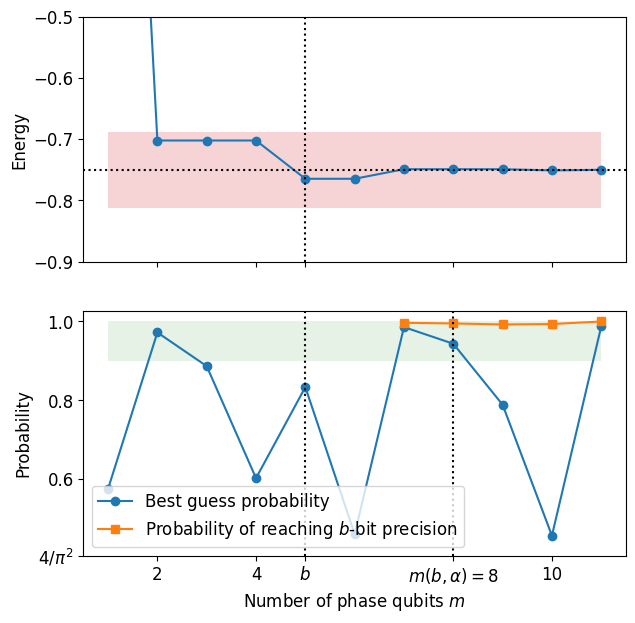
The goal is to measure \(\theta\) with \(b\)-bit precision. For a given “confidence level” \(1-\alpha\) with \(\alpha \in (0,1)\), we are looking for the minimal number of phase qubits \(m(b,\alpha) \geq b\) such that QPE measures \(\theta\) with \(b\)-bit accuracy with a probability of success at least \(1 - \alpha\). Nielsen and Chuang (section 5.2.1.) find that
In their derivation, they take \(m > b + 1\) and introduce the best \(m\)-bit approximation to \(\theta\): \(\theta = a / 2^m + \delta,\) with \(0 < \delta < 1/2^{m+1}\).
Let the QPE output be \(r/2^m\), with \(r\) an integer in the range between \(0\) and \(2^m-1\). Since \(m>b\), \(r\) might be \(1/2^b\)-close to \(\theta\) even if \(r \neq a, a+1\). Indeed, one can verify that if
then
Finally, they show that the probability for QPE to measure \(\theta\) with \(b\)-bit precision is
Thus, setting \(\alpha = \frac{1}{2(2^{m - b} - 2)}\), one finds that to measure \(\theta\) with \(b\)-bit accuracy with a probability of success at least \(1 - \alpha\), one needs a number of phase qubits
Let us now choose \(E_{\rm target} - E_0\) randomly in \([-\Delta/2,\Delta/2)\) and see how the best-guess error and best-guess probability evolve with \(m \geq b\).
First, we slightly modify how we perform QPE in order to compute this probability
def qpe_with_prob_success(
    hamiltonian,
    psi0,
    theta_exact,
    n_phase_bits,
    E_target,
    size_interval,
    n_precision_bits,
):
    """
    Build the circuit and perform the quantum phase estimation algorithm.

    Return the energy, probability and probability of success as defined by Nielsen and Chuang
    """
    E_shift, evolution_time, global_phase = qpe.set_search_window(
        hamiltonian, E_target, size_interval
    )

    initial_circ = make_circ(n_phase_bits, psi0)
    _, probs = qpe.qpe_sample(
        hamiltonian, initial_circ, evolution_time, EXACT, global_phase
    )

    a = np.floor(theta_exact * 2**n_phase_bits)
    prob_success = 0
    if n_precision_bits + 1 < n_phase_bits:
        for x in sorted(enumerate(np.ravel(probs)), key=lambda x: x[1], reverse=True):
            if abs(x[0] - a) < 2 ** (n_phase_bits - n_precision_bits) - 1:
                prob_success += x[1]

    max_prob_state_int = np.argmax(probs)
    theta = max_prob_state_int / 2**n_phase_bits
    energy = E_shift - 2 * np.pi * theta / evolution_time
    return energy, np.max(probs), prob_success
# number of target precision bits
b = 5
# random choice for delta in [-0.5, 0.5)
rng = np.random.default_rng(seed=42)
delta = rng.random() - 1 / 2
size_interval = 2
E_target = E0 + size_interval * delta
theta_exact = (E_target + size_interval / 2 - E0) / size_interval
print(f"exact theta = {theta_exact:.6g}")

probs_success = []
probs = []
energies = []
ms = list(range(1, b + 7))

for n_phase_bits in tqdm.tqdm(ms):
    energy, prob, prob_success = qpe_with_prob_success(
        h_spin,
        psi0_mps,
        theta_exact,
        n_phase_bits,
        E_target,
        size_interval,
        n_precision_bits=b,
    )
    probs_success.append(prob_success)
    probs.append(prob)
    energies.append(energy)
exact theta = 0.773956
def minimal_number_phase_qubits(b, α):
    """Compute the minimal number of phase qubits required
    to reach b-bit precision with probability 1-α.
    """
    return b + np.ceil(np.log2(2 + 1 / (2 * α)))
fig, axs = plt.subplots(nrows=2, sharex=True, figsize=(7, 7))
axs[0].plot(ms, energies, "-o")
axs[0].axhline(y=E0, color="k", linestyle="dotted")
tol = size_interval / 2**b
axs[0].fill_between(ms, [E0 - tol], [E0 + tol], alpha=0.2, facecolor="tab:red")
axs[0].axvline(x=b, color="k", linestyle="dotted")
axs[0].set_ylabel("Energy")
axs[0].set_ylim(-0.9, -0.5)


α = 0.1
print("minimal_number_phase_qubits:", minimal_number_phase_qubits(b, α))

axs[1].plot(ms, probs, "-o", label="Best guess probability")
axs[1].plot(
    ms[b + ms[0] :],
    probs_success[b + ms[0] :],
    "-s",
    label="Probability of reaching $b$-bit precision",
)
axs[1].axvline(x=b, color="k", linestyle="dotted")
axs[1].axvline(x=minimal_number_phase_qubits(b, α), color="k", linestyle="dotted")
axs[1].fill_between(ms, [1 - α], [1], alpha=0.1, facecolor="g")
axs[1].set_ylabel("Probability")
axs[1].set_yticks([4 / np.pi**2, 0.6, 0.8, 1], [r"$4/\pi^2$", "0.6", "0.8", "1.0"])
axs[1].set_xticks([2, 4, 5, 8, 10], ["2", "4", "$b$", r"$m(b,\alpha)=8$", "10"])
axs[1].set_xlabel("Number of phase qubits $m$")
axs[1].legend(loc="lower left");
minimal_number_phase_qubits: 8.0
3.2.4. Precision versus number of phase qubits
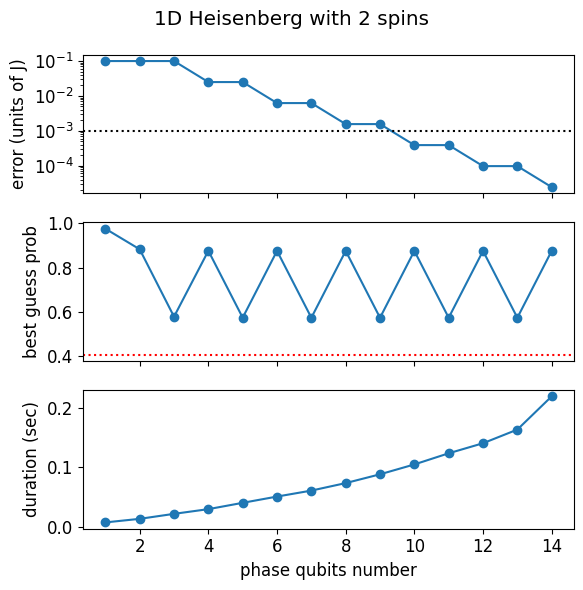
In computational chemistry, the standard level for accuracy is the so-called chemical accuracy, set to \(1\) mHa. In general, matrix elements of chemistry Hamiltonians are of the order of \(1\) Ha. In this example we have fixed the energy unit \(J=1\), we will therefore aim for an error of order \(10^{-3}\).
Assuming that we start with an initial estimate of \(E_0\) with error \(0.1\), what would be the cost in the number of phase qubits to lower the error down to \(10^{-3}\)?
The answer is \(\Delta / 2^{m} \leq 10^{-3}\), i.e. \( m \geq \log_2(10^3 \Delta)\).
E_target = E0 + 0.1
size_interval = 2
print("number of phase bits for 1e-3 accuracy =", int(np.log2(10**3 * size_interval)))
number of phase bits for 1e-3 accuracy = 10
Let us see how the error decreases when increasing the number of phase qubits.
We measure the runtime of the simulation, choosing a greedy optimizer from \(\texttt{quimb}\).
optimize = "greedy"
ms = list(range(1, 15))
energies = []
probs = []
durations = []

for n_phase_bits in tqdm.tqdm(ms):
    initial_circ = make_circ(n_phase_bits, psi0_mps)
    traces, energy = qpe.qpe_energy(
        h_spin,
        initial_circ,
        EXACT,
        E_target,
        size_interval,
        optimize=optimize,
    )
    energies.append(energy)
    probs.append(traces["prob"])
    durations.append(traces["ctimes"][-1])
fig, axs = plt.subplots(nrows=3, sharex=True, figsize=(6, 6), layout="tight")

fig.suptitle(f"1D Heisenberg with {n_qubits} spins")
axs[0].semilogy(ms, [abs(E - E0) for E in energies], "-o")
axs[0].axhline(y=1e-3, color="k", linestyle="dotted")
axs[0].set_ylabel("error (units of J)")

axs[1].plot(ms, probs, "-o")
axs[1].axhline(y=4 / np.pi**2, color="r", linestyle="dotted")
axs[1].set_ylabel("best guess prob")

axs[2].plot(ms, durations, "-o")
axs[2].set_xlabel("phase qubits number")
axs[2].set_ylabel("duration (sec)");
3.2.5. Influence of system size
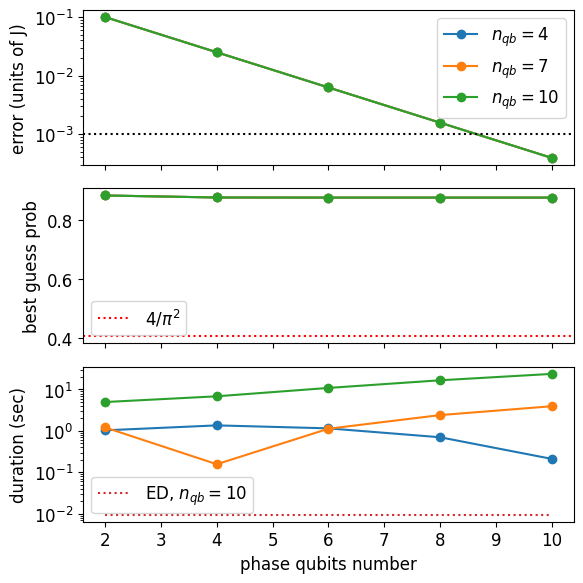
In this section we will investigate the effect of the system size. Recall that the size of the physical register is exactly the number of physical spins in the system. We go up to 10 spins, which corresponds to a Hilbert space of dimension \(2^{10} = 1024\), still within reach of exact diagonalization in a few seconds computation time on a laptop. The following cell may take a few minutes to run.
nqb_list = [4, 7, 10]
ms = [2, 4, 6, 8, 10]

res = {"E0": [], "energies": [], "probs": [], "durations": [], "durations_ed": []}

st0 = time.time()

for n_qubits in tqdm.tqdm(nqb_list):
    h_spin = heisenberg_hamiltonian(n_qubits)

    # Diagonalize hamiltonian
    st_ed = time.time()
    h_sparse = h_spin.to_sparse_matrix()
    eigvals, eigvecs = sla.eigsh(h_sparse, 1, which="SA")
    res["durations_ed"].append(time.time() - st_ed)

    # Ground state
    E0 = eigvals[0]
    res["E0"].append(E0)
    psi0 = eigvecs[:, 0]
    psi0_mps = MatrixProductState.from_dense(psi0)
    E_target = E0 + 0.1
    size_interval = 2

    energies = []
    probs = []
    durations = []
    bond_dims = []
    for n_phase_bits in tqdm.tqdm(ms, leave=False):
        initial_circ = make_circ(n_phase_bits, psi0_mps)
        traces, energy = qpe.qpe_energy(
            h_spin, initial_circ, EXACT, E_target, size_interval, optimize=optimize
        )
        energies.append(energy)
        probs.append(traces["prob"])
        durations.append(traces["ctimes"][-1])

    res["energies"].append(energies)
    res["probs"].append(probs)
    res["durations"].append(durations)
for ind, n_qubits in enumerate(nqb_list):
    plt.plot(ms, res["energies"][ind], "-o", label=f"$n_{{qb}}=${n_qubits}")
plt.ylabel("Energy")
plt.xlabel("phase qubits number")
plt.legend();
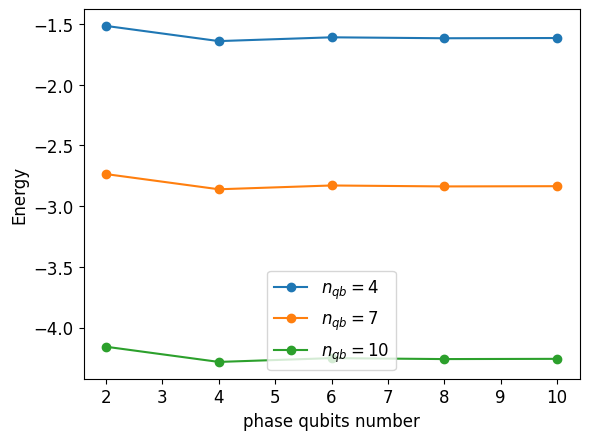
As expected, both the energy error and the success probability are independent of the number of physical qubits.
fig, axs = plt.subplots(nrows=3, figsize=(6, 6), sharex=True, layout="tight")

for ind, n_qubits in enumerate(nqb_list):
    axs[0].semilogy(
        ms,
        [abs(E - res["E0"][ind]) for E in res["energies"][ind]],
        "-o",
        label=f"$n_{{qb}}=${n_qubits}",
    )
    axs[1].plot(ms, res["probs"][ind], "-o")
    axs[2].semilogy(ms, res["durations"][ind], "-o")


axs[0].axhline(y=1e-3, color="k", linestyle="dotted")
axs[0].set_ylabel("error (units of J)")
axs[0].legend()
axs[1].axhline(y=4 / np.pi**2, color="r", linestyle="dotted", label=r"$4/\pi^2$")
axs[1].set_ylabel("best guess prob")
axs[2].semilogy(
    ms,
    [res["durations_ed"][ind] for _ in ms],
    linestyle="dotted",
    label=f"ED, $n_{{qb}}=${n_qubits}",
)
axs[2].set_xlabel("phase qubits number")
axs[2].set_ylabel("duration (sec)")
axs[2].legend()
axs[1].legend();
3.2.6. Influence of interval size and target energy
We now vary the energy interval \(\Delta\) and the target energy \(E_{target}\) within an interval \([E_0 - \Delta / 2, E_0 + \Delta/2]\). Outside of this range, errors are guaranteed, because \(\exp(i\phi)\) is \(2\pi\)-periodic and distinct energies outside \([E_0 - \Delta/2, E_0 + \Delta/2]\) map to the same phase.
n_qubits = 4
h_spin = heisenberg_hamiltonian(n_qubits)
E0, psi0_mps = do_dmrg(h_spin)

n_phase_bits = 10
initial_circ = make_circ(n_phase_bits, psi0_mps)

interval_sizes = np.arange(0.2 * abs(E0), 4 * abs(E0), 0.9 * abs(E0))
interval_energies = []
n_energy_targets = 11
for Δ in tqdm.tqdm(interval_sizes):
    assert Δ > 0
    energy_targets = E0 + Δ * np.linspace(-0.5, 0.4, n_energy_targets)
    energies_Δ = np.empty_like(energy_targets)
    for i in tqdm.tqdm(range(n_energy_targets), leave=False):
        _, energies_Δ[i] = qpe.qpe_energy(
            h_spin, initial_circ, EXACT, energy_targets[i], Δ
        )
    interval_energies.append(energies_Δ)
fig, ax = plt.subplots()
for Δ, energies_Δ in zip(interval_sizes, interval_energies, strict=True):
    energy_targets = E0 + Δ * np.linspace(-0.5, 0.4, n_energy_targets)
    label = rf"$\Delta={Δ / abs(E0):.2f}E_0$"
    ax.plot(energy_targets - E0, energies_Δ - E0, "-o", label=label)

ax.set_xlabel("$E_{target} - E_0$")
ax.set_ylabel("$E - E_0$")
fig.suptitle(f"{n_phase_bits} phase qubits")
ax.legend();
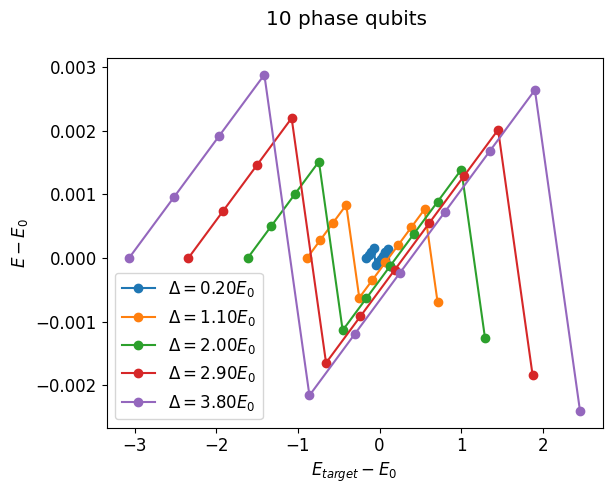
Note that the smaller the size \(\Delta\) of the search window, the smaller the error, provided \(E_0 \in [E_{\rm target}-\Delta/2, E_{\rm target}+\Delta/2]\).
3.3. Effect of initial state overlap
So far we had initialized the circuit with \(|\psi_0\rangle\). In practice, we do not have a priori access to the exact \(|\psi_0\rangle\), but only an approximate state with some overlap \(\Omega\). The probability of success of QPE is then proportional to \(\Omega\).
For simplicity, let us consider the first excited state \(\ket{\psi_1}\) only and initialize the physical register in the state
# Get matrix
hamilt_qarray = h_spin.to_dense()

# Diagonalize hamiltonian
eigvals, eigvecs = np.linalg.eigh(hamilt_qarray)

# Ground state
E0 = eigvals[0]
psi0 = eigvecs[:, 0]

# First excited
E1 = eigvals[1]
psi1 = eigvecs[:, 1]
size_interval = 2
E_target = E0 + 0.2  # 1 / 2**5 * size_interval

n_phase_bits = 5
Omegas = np.arange(1, -0.1, -0.1)

E_o = []
p_o = []
for Omega in Omegas:
    psi_target = np.sqrt(Omega) * psi0 + np.sqrt(1 - Omega) * psi1
    psi_target_mps = MatrixProductState.from_dense(psi_target)

    initial_circ = make_circ(n_phase_bits, psi_target_mps)
    traces_o, energy_o = qpe.qpe_energy(
        h_spin, initial_circ, EXACT, E_target, size_interval
    )
    E_o.append(energy_o)
    p_o.append(traces_o["prob"])
We plot the energy and probability outputs as a function of \(\Omega\):
fig, (ax_e, ax_p) = plt.subplots(2, 1, sharex=True)
ax_e.plot(Omegas, E_o, "-o")
ax_e.axhline(y=E0, color="k", linestyle=":", alpha=0.5)
ax_e.axhline(y=E1, color="k", linestyle=":", alpha=0.5)
ax_e.axvline(x=p_o[-1] / (p_o[0] + p_o[-1]), color="k", linestyle=":", alpha=0.5)
ax_e.set_ylabel("Energy E")
ax_e.set_yticks([E0, E1], ["$E_0$", "$E_1$"])
ax_e.xaxis.set_inverted(True)

ax_p.plot(Omegas, p_o, "-o", color="tab:orange")
ax_p.plot(Omegas, p_o[0] * Omegas, color="k", linestyle=":", alpha=0.5)
ax_p.plot(Omegas, p_o[-1] * (1 - Omegas), color="k", linestyle=":", alpha=0.5)
ax_p.axvline(x=p_o[-1] / (p_o[0] + p_o[-1]), color="k", linestyle=":", alpha=0.5)
ax_p.set_xticks(
    [0, p_o[-1] / (p_o[0] + p_o[-1]), 1], ["0", "$\\frac{p(0)}{p(0) + p(1)}$", "1"]
)
ax_p.set_ylabel("Probability p")
ax_p.set_xlabel(r"$\Omega$")
ax_p.xaxis.set_inverted(True)

fig.suptitle(
    r"QPE with initial state $\sqrt{\Omega} | \psi_0 \rangle + \sqrt{1-\Omega} | \psi_1 \rangle$"
);
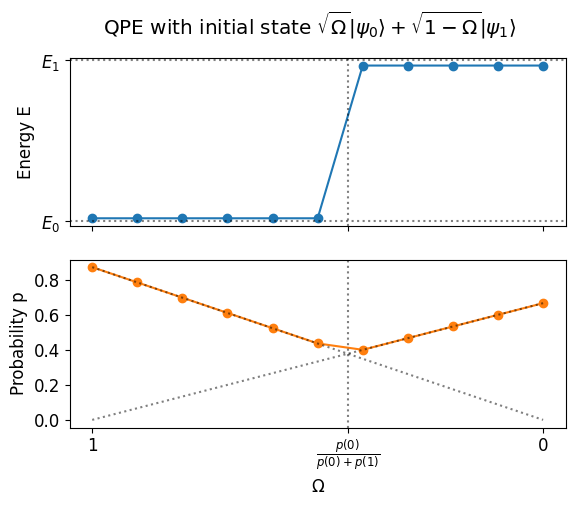
When \(\Omega=1\) (resp. \(\Omega=0\)), the physical register is in \(\ket{\psi_0}\) (resp. \(\ket{\psi_1}\)). The QPE energy is close but not equal to \(E_0\) (resp. \(E_1\)) and the success probability is \(<1\). Both the energy error and the success probability depend on the number of phase qubits and on the search window parameters \(E_{\rm target}\) and \(\Delta\).
Starting from \(\Omega=1\) and decreasing \(\Omega\), the success probability decreases linearly: \(p(\Omega) = p(\Omega = 1)\Omega,\) while the output energy remains constant and close to \(E_0\).
There is a crossover for \(\Omega^* = p(0)/(p(0) + p(1)),\) where we switch from measuring \(E_0\) to measuring \(E_1\).
For \(\Omega < \Omega^*\), the probability varies like: \(p(\Omega) = p(\Omega = 0) (1-\Omega),\) while the energy output remains constant and close to \(E_1\), corresponding to an increasing overlap of the initial state with the first excited state.
To go further, we encourage the reader to try starting with a state \(\sqrt{\Omega} \ket{\psi_0} + \sqrt{\frac{1-\Omega}{N-1}} \sum_{k=1}^N \ket{\psi_k}.\)