6. QPE with Linear Combination of Unitaries
In this notebook, we introduce advanced techniques for encoding the Hamiltonian into a unitary: Linear Combination of Unitaries and Qubitization. These techniques were first introduced in the context of Hamiltonian simulation and later applied to phase estimation.
We mainly take inspiration from Lin Lin’s lecture notes on Quantum Algorithms for Scientific Computation and from the paper Encoding Electronic Spectra in Quantum Circuits with Linear T Complexity, Babbush et al., PRX 8, 041015 (2018). The interested reader is referred to these works and references therein for the original derivations.
import time

import matplotlib.pyplot as plt
import numpy as np
import quimb.tensor as qtn
from IPython.display import display
from pyscf import gto
from tqdm import notebook as tqdm

import qpe_toolbox.estimation as qpe
from qpe_toolbox.hamiltonian import (
    chemistry_hamiltonian,
    do_dmrg,
    heisenberg_hamiltonian,
)
from qpe_toolbox.tensor import apply_gate_from_mpo, kron_mps
plt.rcParams.update({"font.size": 12})
Initialization: the Linear Combination of Unitaries approach begins by rewriting the Hamiltonian into a sum of unitaries:
where \(H_\ell^2 = \mathbb{1}\) expresses the condition that \(H_\ell\) is Hermitian and unitary.
Spin-\(1/2\) Hamiltonians are natively written in this form since Pauli matrices are Hermitian and unitary. For fermionic Hamiltonians, this decomposition can be done e.g. via the Jordan-Wigner transformation.
The weights \(w_\ell\) are defined to be positive (if needed the phase of \(w_\ell\) can always be absorbed by a re-definition of the unitary \(H_\ell\).)
We define the sum of weights, often referred to as the “1-norm” of the LCU:
Note that the cost of Quantum Phase Estimation scales with the 1-norm \(\lambda\). There is a lot of research activity devoted to compressing the Hamiltonian and reducing \(\lambda\), see e.g. this work and this more recent work and references therein. These advanced LCU techniques are beyond the scope of this simple introduction, where we consider a naive LCU based on the Pauli decomposition of \(H\).
We then introduce an empty ancilla register of size \(m_L\).
In the case where \(L < 2^{m_L}\) we complete the weights up to \(2^{m_L}\) by setting
We consider the 1D Heisenberg model with 4 spins.
n_qubits = 4
H = heisenberg_hamiltonian(n_qubits)

weights, λ, L, m_L = qpe.get_lcu_weights(H)
print(f"LCU decomposition with {L} terms")
print(f"Auxiliary register with {m_L} qubits")
print(f"1-norm of LCU coefficients: lambda = {λ:.3f}")

# DMRG E0 and psi0
E0_dmrg, psi0_mps = do_dmrg(H)
print(f"DMRG energy: E0 = {E0_dmrg:.3f}")
LCU decomposition with 9 terms
Auxiliary register with 4 qubits
1-norm of LCU coefficients: lambda = 2.250
DMRG energy: E0 = -1.616
The LCU scheme involves two oracles: PREPARE and SELECT, which we introduce below.
6.1. \(\ell\)-register and PREPARE oracle
The PREPARE oracle acts on the \(m_L\) qubits of the auxiliary \(\ell\)-register to prepare a superposition state related to the LCU decomposition:
The quantum circuit implementation of the PREPARE oracle relies on complicated subroutines like unary iteration and QROM (see this paper cited in the introduction), that are beyond the scope of this introduction. Here, we consider a simple implementation of PREPARE as an MPO. It will be sufficient to introduce the general ideas of LCU-based qubitization.
prepare_mpo = qpe.build_lcu_prepare_mpo(H)
The state prepared by the action of the PREPARE oracle is called the \(\ket{\mathcal{L}}\) state:
zero_mps = qtn.MPS_computational_state("0" * m_L)
L_mps = prepare_mpo.apply(zero_mps)
Alternatively, the \(\ket{\mathcal{L}}\) state can be built directly by calling the build_lcu_prepare_state_mps function.
overlap = L_mps.overlap(qpe.build_lcu_prepare_state_mps(H))
print(f"overlap (should be 1) = {overlap:.3f}")
overlap (should be 1) = 1.000
6.2. SELECT oracle gate
Let us then introduce the second LCU oracle, the SELECT oracle. It is a unitary operation acting on both the auxiliary \(\ell\)-register and the physical register following
Note that for any \(\ket{\psi}\) we have:
i.e. the combination of SELECT and PREPARE gives an encoding of the Hamiltonian. This property allows us to construct a unitary operator: \(\mathcal{W}\), the walk operator, that gives an exact encoding of the spectrum of \(H\) via a technique called qubitization.
select_gates = qpe.lcu_select_gates(H)
In our simple example of a spin Hamiltonian, the unitaries \(H_\ell\) are Pauli strings (\(XX, YY, ZZ\)). Note that for LCU of chemistry Hamiltonians, more advanced schemes like Single Factorization, Double Factorization, Tensor Hyper Contraction… are introduced where the unitaries \(H_\ell\) no longer coincide with Pauli strings (see e.g. this work on Tensor Hyper Contraction for a discussion).
print(*select_gates[:10], sep="\n")
<Gate(label=X, params=[], qubits=(0,))>
<Gate(label=X, params=[], qubits=(1,))>
<Gate(label=X, params=[], qubits=(2,))>
<Gate(label=X, params=[], qubits=(3,))>
<Gate(label=X, params=[], qubits=(4,), controls=(0, 1, 2, 3)))>
<Gate(label=X, params=[], qubits=(5,), controls=(0, 1, 2, 3)))>
<Gate(label=X, params=[], qubits=(0,))>
<Gate(label=X, params=[], qubits=(1,))>
<Gate(label=X, params=[], qubits=(2,))>
<Gate(label=X, params=[], qubits=(3,))>
The first gates correspond to \(\ket{0}\bra{0} \otimes X_0 X_1\) in “Hamiltonian” notation, where \(X_i\) represents the \(X\) Pauli matrix acting on the \(i\)-th spin of the Heisenberg model, or \(i\)-th physical qubit. Since the physical register indexing is shifted by \(m_L=4\) to avoid confusion with the auxiliary \(\ell\)-register, the first and second qubits of the physical register (index \(0\) and \(1\) in the physical register “local” indexing) correspond to qubit \(4\) and \(5\) in the total register.
We start by projecting \(\ket{0}^{\otimes m_L}\) onto \(\ket{1}^{\otimes m_L}\) (apply \(X\) on qubits \(0\) to \(3\)), then apply a controlled-\(X\) on qubit \(4\) and \(5\), then apply the reversed projection \(\ket{0}^{\otimes m_L} \bra{1}^{\otimes m_L}\).
Note that qubits in the \(\ell\)-register are indexed from \(0\) to \(m_L-1\). Qubits in the physical register are indexed from \(m_L\) to \(m_L + n - 1\).
Applying the SELECT oracle on \(\ket{\mathcal{L}}\ket{\psi_0}\), and projecting onto the same state, we obtain an estimate of the ground state energy:
Lpsi_mps = kron_mps(L_mps, psi0_mps)

circ = qtn.CircuitMPS(psi0=Lpsi_mps)
for gate in select_gates:
    circ.apply_gate(gate)

assert np.isclose(Lpsi_mps.H @ circ.psi, E0_dmrg / λ)
Proof:
6.3. Walk operator
We are now ready to build the walk operator, defined by
First we define \(\mathcal{R}_L\) as an MPO. Since we simulate quantum circuits as tensor networks we can always replace any part of the circuit by an MPO. In a real QPU one would need to build a Householder reflection circuit that involves a \(\mathrm{PREPARE}\) and \(\mathrm{PREPARE}^\dagger\). The implementation of these oracles as quantum circuits is complex and beyond the scope of this introduction.
6.3.1. Reflection as an MPO
The PREPARE oracle is key to building a reflection operator:
that appears in the definition of the walk operator.
Here, we build this reflection as an MPO.
R_L = qpe.build_lcu_reflection_mpo(H)
display(R_L)
MatrixProductOperator(tensors=8, indices=23, L=8, max_bond=5)
Tensor(shape=(4, 2, 2), inds=[_976645AAAMM, k0, b0], tags={I0}),
backend=numpy, dtype=float64, data=array([[[ 1.04515342e+01, -1.02364420e-15], [ 1.13236785e-15, 1.04515342e+01]], [[-3.49796120e+00, -9.99417487e-01], [-9.99417487e-01, 3.49796120e+00]], [[-1.09050138e-01, -1.23321275e+00], [ 1.99656371e+00, 1.09050138e-01]], [[ 4.43643916e-01, -1.94970220e+00], [-1.15580521e+00, -4.43643916e-01]]])Tensor(shape=(4, 5, 2, 2), inds=[_976645AAAMM, _976645AAAMN, k1, b1], tags={I1}),
backend=numpy, dtype=float64, data=array([[[[ 0.67451694, -0.06166299], [-0.06166299, 0.69468154]], [[-0.04665332, -0.15785471], [-0.15785471, -0.04140364]], [[-0.00500879, 0.00500879], [ 0.00500879, 0.00500879]], [[ 0.0128554 , -0.0128554 ], [-0.0128554 , -0.0128554 ]], [[-0.01282738, -0.00472332], [-0.00472332, 0.01192642]]], [[[ 0.13789783, 0.18196886], [ 0.18196886, 0.17033734]], [[ 0.49156396, 0.47106109], [ 0.47106109, 0.43605654]], [[-0.01383625, -0.03830101], [ 0.03830101, -0.01383625]], [[ 0.03551165, -0.01492305], [ 0.01492305, 0.03551165]], [[-0.05878383, 0.01132176], [ 0.01132176, 0.01304765]]], [[[-0.0254137 , -0.08579002], [ 0.09410063, 0.0254137 ]], [[-0.06505801, -0.2696048 ], [ 0.2717684 , 0.06505801]], [[ 0.53558691, 0.23183233], [ 0.3058189 , -0.00206432]], [[ 0.37649758, 0.48748184], [-0.11628246, 0.00529821]], [[-0.00194666, 0.01844716], [-0.00824516, 0.00194666]]], [[[ 0.10338944, -0.03901391], [ 0.00520421, -0.10338944]], [[ 0.26467268, -0.0709373 ], [ 0.06213524, -0.26467268]], [[ 0.37655396, -0.12700395], [ 0.49515974, 0.00839817]], [[-0.53601648, -0.30068923], [-0.21377279, -0.02155446]], [[ 0.00791952, -0.01747161], [-0.02403273, -0.00791952]]]])Tensor(shape=(5, 4, 2, 2), inds=[_976645AAAMN, _976645AAAMO, k2, b2], tags={I2}),
backend=numpy, dtype=float64, data=array([[[[-6.89339542e-01, 6.20104652e-02], [ 6.20104652e-02, -7.08073302e-01]], [[ 6.20231399e-02, 6.13025990e-02], [ 6.13025990e-02, 6.33637224e-02]], [[-1.11266573e-02, 9.52356129e-03], [ 9.52356129e-03, 7.92046530e-03]], [[-8.02854483e-17, 1.84636758e-03], [-1.84636758e-03, 4.01524424e-17]]], [[[-1.29913331e-01, -4.01616694e-01], [-4.01616694e-01, -8.52402242e-02]], [[-4.35656780e-01, -4.02465411e-01], [-4.02465411e-01, -3.66914958e-01]], [[-9.43633455e-03, -1.82140176e-02], [-1.82140176e-02, -4.58643698e-02]], [[-1.10754523e-16, 3.18463237e-02], [-3.18463237e-02, -5.59146521e-17]]], [[[-1.11050204e-01, 2.82860855e-01], [-2.55098304e-01, 1.11050204e-01]], [[-1.10192660e-01, 3.01987057e-01], [-2.98543537e-01, 1.10192660e-01]], [[ 2.10054759e-01, -1.35399337e-01], [ 3.31680014e-01, 1.37740825e-02]], [[-5.37959159e-01, -1.71810651e-01], [-3.66148508e-01, 2.24357488e-17]]], [[[ 2.85017725e-01, 6.91741159e-02], [-1.40428547e-01, -2.85017725e-01]], [[ 2.82816783e-01, 1.12572036e-01], [-1.21410060e-01, -2.82816783e-01]], [[-5.39119493e-01, -3.42876735e-01], [-1.60890660e-01, -3.53520979e-02]], [[-2.09602663e-01, -3.54191841e-01], [ 1.44589178e-01, -2.96863953e-17]]], [[[-2.84662848e-01, -7.96313779e-03], [-7.96313779e-03, 2.53901002e-01]], [[ 2.29543206e-01, 3.01290390e-02], [ 3.01290390e-02, -3.12147121e-01]], [[ 5.71447972e-01, -3.05233181e-01], [-3.05233181e-01, -3.90183901e-02]], [[ 2.43675178e-15, -3.06613180e-01], [ 3.06613180e-01, -5.73326208e-17]]]])Tensor(shape=(4, 1, 2, 2), inds=[_976645AAAMO, _976645AAAMP, k3, b3], tags={I3}),
backend=numpy, dtype=float64, data=array([[[[-7.07106781e-01, -4.25097092e-17], [-1.46639862e-16, -7.07106781e-01]]], [[[-8.77058019e-02, -7.01646415e-01], [-7.01646415e-01, 8.77058019e-02]]], [[[ 7.01646415e-01, -8.77058019e-02], [-8.77058019e-02, -7.01646415e-01]]], [[[-0.00000000e+00, 7.07106781e-01], [-7.07106781e-01, -3.00312117e-16]]]])Tensor(shape=(1, 1, 2, 2), inds=[_976645AAAMP, _976645AAAMQ, k4, b4], tags={I4}),
backend=numpy, dtype=float64, data=array([[[[0.70710678, 0. ], [0. , 0.70710678]]]])Tensor(shape=(1, 1, 2, 2), inds=[_976645AAAMQ, _976645AAAMR, k5, b5], tags={I5}),
backend=numpy, dtype=float64, data=array([[[[0.70710678, 0. ], [0. , 0.70710678]]]])Tensor(shape=(1, 1, 2, 2), inds=[_976645AAAMR, _976645AAAMS, k6, b6], tags={I6}),
backend=numpy, dtype=float64, data=array([[[[0.70710678, 0. ], [0. , 0.70710678]]]])Tensor(shape=(1, 2, 2), inds=[_976645AAAMS, k7, b7], tags={I7}),
backend=numpy, dtype=float64, data=array([[[-0.70710678, 0. ], [ 0. , -0.70710678]]])6.3.2. Walk operator
Let us apply SELECT on the \(\ket{\mathcal{L}}\ket{\psi}\) state.
circ = qtn.CircuitMPS(psi0=Lpsi_mps)

select_gates = qpe.lcu_select_gates(H)
for gate in select_gates:
    circ.apply_gate(gate)

select_Lpsi = circ.psi
For an eigenstate \(\ket{\psi_k}\) with eigenvalue \(E_k\), the action of \(\mathcal{W}\) on \(\ket{\mathcal{L}}\ket{\psi_k}\) spans a two-dimensional space defined by \(\ket{\psi_k}\) and an orthogonal state \(\ket{\phi_k}\)
where \(\ket{\phi_k}\) is:
By definition of \(\ket{\phi_k}\), we have \(\bra{\psi_k}\bra{\mathcal{L}} \ket{\phi_k} = 0.\)
phi = (select_Lpsi - E0_dmrg / λ * Lpsi_mps) / np.sqrt(1 - (E0_dmrg / λ) ** 2)
assert np.isclose(abs(phi.H @ Lpsi_mps) ** 2, 0)
Now let us apply the reflection \(\mathcal{R}_L\) to get \(\mathcal{W}\).
\(\mathcal{W}\) has the following matrix elements:
and
circ_final = apply_gate_from_mpo(circ=circ, mpo=R_L)
psi_final = circ_final.psi.copy()

assert np.isclose(Lpsi_mps.H @ psi_final, E0_dmrg / λ)
assert np.isclose(phi.H @ psi_final, -np.sqrt(1 - (E0_dmrg / λ) ** 2))
In the basis \(\{ \ket{\mathcal{L}}\ket{\psi_k}, \ket{\phi_k} \}\), the walk operator reads
where we have introduced the \(Y\) Pauli matrix.
Proof: let us define
plus_state = 1 / np.sqrt(2) * (Lpsi_mps + 1j * phi)
minus_state = 1 / np.sqrt(2) * (Lpsi_mps - 1j * phi)
and check that
assert np.isclose(
    plus_state.H @ psi_final, np.exp(1j * np.arccos(E0_dmrg / λ)) / np.sqrt(2)
)
assert np.isclose(
    minus_state.H @ psi_final, np.exp(-1j * np.arccos(E0_dmrg / λ)) / np.sqrt(2)
)
Thus, the action of \(\mathcal{W}\) on \(\ket{\mathcal{L}}\ket{\psi_k}\) spans a two-dimensional space in which its eigenphases are exact functions of the energy \(E_k\). We can therefore apply the QPE algorithm on \(\mathcal{W}\) to find \(E_k\).
6.4. QPE on walk operator
The run_qpe_lcu_walk_operator function from the estimation module builds the walk operator using the functions introduced above and runs the “textbook” QPE circuit using \(\mathcal{W}\) as the unitary. For simplicity, we use the standard QPE circuit, in which the full walk operator \(\mathcal{W}\) is controlled by the phase qubits. Crucially, we do not apply the last optimization from Babbush et al., PRX 8, 041015 (2018), where only the SELECT circuits are controlled by the phase qubits (right panel of Fig 1).
n_phase_qubits = 4
traces, theta = qpe.run_qpe_lcu_walk_operator(H, psi0_mps, n_phase_qubits, verbosity=1)
binary      	 ket    	 phase  	 prob
1010         	 |10>     	 0.6250 	 0.4974
0110         	 |6>      	 0.3750 	 0.4974
0111         	 |7>      	 0.4375 	 0.0010
Now we compute the energy from the eigenphase of \(\mathcal{W}\):
energy = qpe.get_energy_from_lcu_walk_phase(theta, λ)
print(f"energy = {energy:.4f}")
energy = -1.5910
The QPE circuit returns a measurement of \(\theta\) with precision of order \(\Delta\theta = 1/2^{m}\) where \(m\) is the number of phase qubits (in reality one needs slightly more than \(m\) phase qubits to reach this precision with guarantees, see the tutorial on Textbook QPE.) The precision on \(E\) is then
print(f"error = {abs(E0_dmrg - energy):.4f}")
delta_e = qpe.estimate_lcu_error(n_phase_qubits, E0_dmrg, λ)
print(f"error bound = {delta_e:.4f}")
error = 0.0250
error bound = 0.6148
Let us now vary the number of phase qubits
thetas = []
n_phase_bits_arr = np.arange(2, 6)
durations = []
energies = []
for m_ph in tqdm.tqdm(n_phase_bits_arr):
    st = time.time()
    traces, theta = qpe.run_qpe_lcu_walk_operator(H, psi0_mps, m_ph)
    thetas.append(theta)
    durations.append(time.time() - st)
    energies.append(qpe.get_energy_from_lcu_walk_phase(theta, λ))
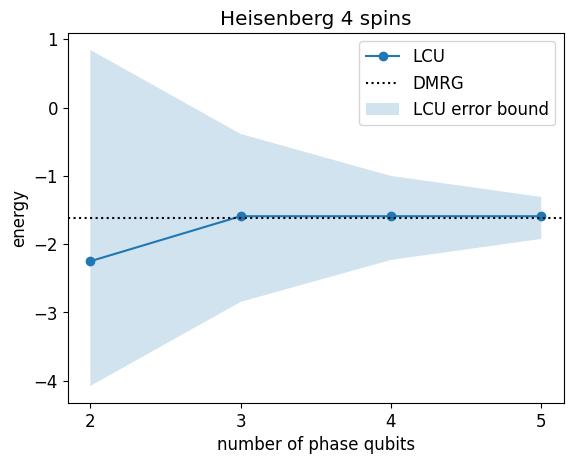
We plot the energy as a function of the number of phase qubits to see how the precision evolves
delta_es = [qpe.estimate_lcu_error(m_ph, E0_dmrg, λ) for m_ph in n_phase_bits_arr]

plt.plot(n_phase_bits_arr, energies, "-o", label="LCU")
plt.axhline(y=E0_dmrg, color="k", linestyle=":", label="DMRG")
plt.fill_between(
    n_phase_bits_arr,
    [E0_dmrg + delta_e for delta_e in delta_es],
    [E0_dmrg - delta_e for delta_e in delta_es],
    alpha=0.2,
    label="LCU error bound",
)
plt.legend()
plt.xticks(n_phase_bits_arr)
plt.title(f"Heisenberg {H.n_qubits} spins")
plt.ylabel("energy")
plt.xlabel("number of phase qubits");
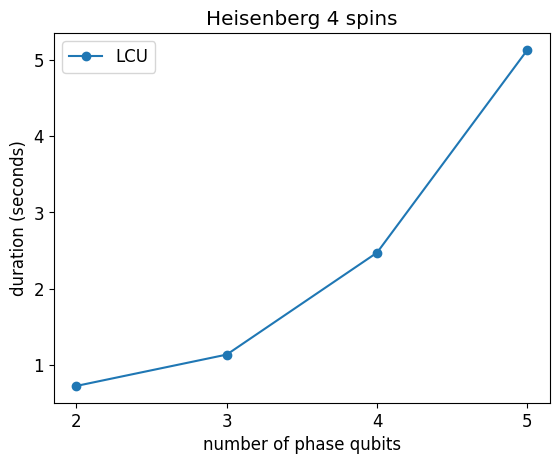
plt.plot(n_phase_bits_arr, durations, "-o", label="LCU")
plt.legend()
plt.ylabel("duration (seconds)")
plt.xticks(n_phase_bits_arr)
plt.xlabel("number of phase qubits")
plt.title(f"Heisenberg {H.n_qubits} spins");
6.5. Compare with second order Trotter
Let’s compare with QPE applied on a Trotter approximation of the time-evolution operator.
res_ttr = {"durations": [], "energies": []}
E_target = E0_dmrg + 0.2
size_interval = 2.0
trotter_order = 2
n_steps = 6

for m_ph in tqdm.tqdm(n_phase_bits_arr):
    zeros_mph = qtn.MPS_computational_state("0" * m_ph)
    psi_init = kron_mps(zeros_mph, psi0_mps)
    init_circ = qtn.CircuitMPS(psi0=psi_init, cutoff=1e-10)
    traces, energy = qpe.qpe_energy(
        H, init_circ, n_steps, E_target, size_interval, trotter_order=trotter_order
    )
    res_ttr["durations"].append(traces["ctimes"][-1])
    res_ttr["energies"].append(energy)
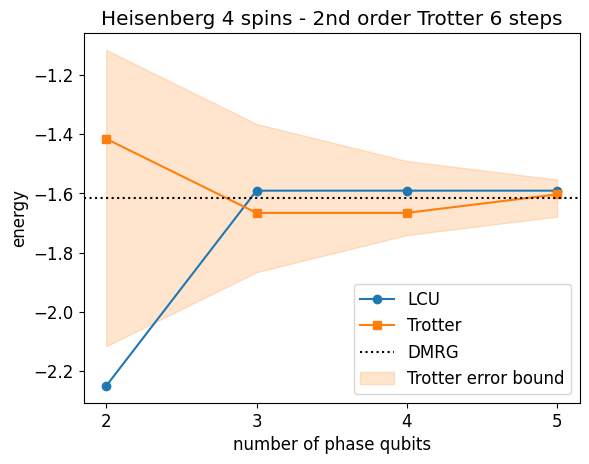
We visualize the convergence of the energy with the number of phase qubits
plt.plot(n_phase_bits_arr, energies, "-o", label="LCU")
(trotter_line,) = plt.plot(n_phase_bits_arr, res_ttr["energies"], "-s", label="Trotter")
plt.axhline(y=E0_dmrg, color="k", linestyle=":", label="DMRG")
plt.fill_between(
    n_phase_bits_arr,
    E0_dmrg + size_interval / 2**n_phase_bits_arr,
    E0_dmrg - size_interval / 2**n_phase_bits_arr,
    alpha=0.2,
    label="Trotter error bound",
    color=trotter_line.get_color(),
)
plt.legend()
plt.title(f"Heisenberg {H.n_qubits} spins - 2nd order Trotter {n_steps} steps")
plt.ylabel("energy")
plt.xticks(n_phase_bits_arr)
plt.xlabel("number of phase qubits");
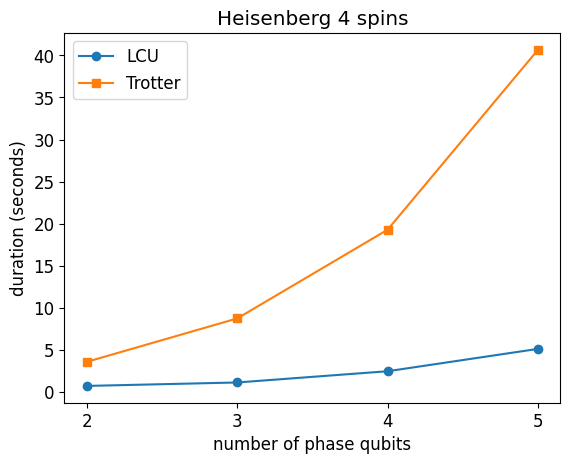
The computation is much longer, although the comparison is not completely fair. Indeed, in the LCU-based QPE we apply the REFLECT oracle as an MPO, which translates into fewer gates to apply and fewer operations in the simulation (here the simulation time is mainly due to the number of operations, since we work with small systems the bond dimension remains small).
plt.plot(n_phase_bits_arr, durations, "-o", label="LCU")
plt.plot(n_phase_bits_arr, res_ttr["durations"], "-s", label="Trotter")
plt.legend()
plt.xticks(n_phase_bits_arr)
plt.ylabel("duration (seconds)")
plt.xlabel("number of phase qubits")
plt.title(f"Heisenberg {H.n_qubits} spins");
6.6. Quantum chemistry example: diatomic Hydrogen
As an illustration of the use of QPE in quantum chemistry, we apply LCU to the molecular Hamiltonian describing H\(_2\) in the minimal atomic orbital basis:
mol = gto.M(
    atom=[("H", (0.0, 0.0, 0.0)), ("H", (0.0, 0.0, 0.735))],
    basis="STO-3G",
)

H_H2 = chemistry_hamiltonian(
    mol, hf_mode="rhf", encoding="original", do_fci=True, do_ccsd=False
)
converged SCF energy = -1.116998996754
nOrb   : 2
nElec  : 2
E_HF   : -1.1169989968
E_CI : -1.1373060358
# LCU weights and related figures
weights_H2, λ_H2, L_H2, mL_H2 = qpe.get_lcu_weights(H_H2)
# DMRG energy and state
E0_H2, psi0_H2 = do_dmrg(H_H2)

print(f"E_DMRG : {E0_H2 + H_H2.e_const:.10f}")
print(f"L={L_H2} terms in the LCU decomposition \nLCU 1-norm λ = {λ_H2:.4f}")
E_DMRG : -1.1373060358
L=14 terms in the LCU decomposition
LCU 1-norm λ = 1.8945
m_ph = 4  # number of phase qubits

# QPE on walk operator
traces, theta = qpe.run_qpe_lcu_walk_operator(H_H2, psi0_H2, m_ph, verbosity=1)
# Get the energy
energy = qpe.get_energy_from_lcu_walk_phase(theta, λ_H2)
print(f"\nenergy = {energy + H_H2.e_const:.4f}, error = {abs(E0_H2 - energy):.4f}")
# Check error bound
delta_e = qpe.estimate_lcu_error(m_ph, E0_H2, λ_H2)
print(f"error bound = {delta_e:.4f}")
binary      	 ket    	 phase  	 prob
0101         	 |5>      	 0.3125 	 0.2134
1011         	 |11>     	 0.6875 	 0.2134
1010         	 |10>     	 0.6250 	 0.1990

energy = -0.8156, error = 0.3217
error bound = 0.6201
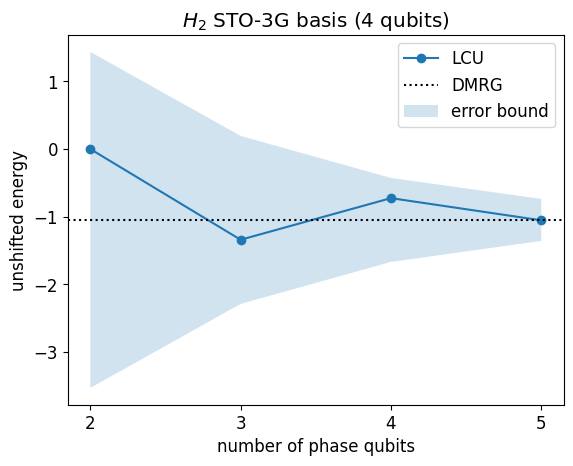
Let us plot the energy for growing number of phase qubits
thetas = []
n_phase_bits_arr = np.arange(2, 6)
durations_H2 = []
energies_H2 = []
for m_ph in tqdm.tqdm(n_phase_bits_arr):
    st = time.time()
    traces, theta = qpe.run_qpe_lcu_walk_operator(H_H2, psi0_H2, m_ph)
    thetas.append(theta)
    durations_H2.append(time.time() - st)
    energies_H2.append(qpe.get_energy_from_lcu_walk_phase(theta, λ_H2))
delta_es = np.array(
    [qpe.estimate_lcu_error(m_ph, E0_H2, λ_H2) for m_ph in n_phase_bits_arr]
)

plt.plot(n_phase_bits_arr, energies_H2, "-o", label="LCU")
plt.axhline(y=E0_H2, color="k", linestyle=":", label="DMRG")
plt.fill_between(
    n_phase_bits_arr, E0_H2 + delta_es, E0_H2 - delta_es, alpha=0.2, label="error bound"
)
plt.legend()
plt.xticks(n_phase_bits_arr)
plt.title(f"$H_2$ STO-3G basis ({H_H2.n_qubits} qubits)")
plt.ylabel("unshifted energy")
plt.xlabel("number of phase qubits");
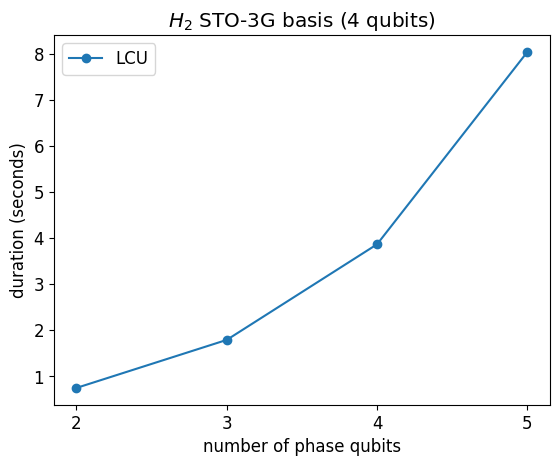
plt.plot(n_phase_bits_arr, durations_H2, "-o", label="LCU")
plt.ylabel("duration (seconds)")
plt.xticks(n_phase_bits_arr)
plt.xlabel("number of phase qubits")
plt.legend()
plt.title(f"$H_2$ STO-3G basis ({H_H2.n_qubits} qubits)")
Text(0.5, 1.0, '$H_2$ STO-3G basis (4 qubits)')