1. Basic usage of SpinPulse
In this notebook, we present the basic usage of the SpinPulse package.
We first show how to transpile a qiskit.QuantumCircuit into a spin_pulse.PulseCircuit.
We then demonstrate how to use the .to_circuit() method to obtain a qiskit.QuantumCircuit that represents the initial circuit executed on spin qubits.
The implementation of noise at the circuit level is then presented, and we conclude by studying the effect of dynamical decoupling.
1.1. Hardware Specs definition
We begin by creating an HardwareSpecs instance that specifies the parameters of our spin-qubit quantum computer.
See the ParametrizingfromQPUSpecs example for hardware specifications tailored to spin-qubit hardware.
%load_ext autoreload
%autoreload 2
import qiskit as qi

from spin_pulse.environment.noise import NoiseType
from spin_pulse.transpilation.hardware_specs import HardwareSpecs, Shape

num_qubits = 3
B_field, delta, J_coupling = 0.5, 0.2, 0.01
ramp_duration = 5
hardware_specs = HardwareSpecs(
    num_qubits, B_field, delta, J_coupling, Shape.GAUSSIAN, ramp_duration, optim=3
)
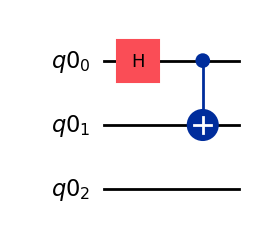
Then we specify a quantum circuit that we would like to implement and simulate. Here the circuit is simply made of a CNOT on the first two qubits, while the third qubit remains at rest.
qreg = qi.QuantumRegister(num_qubits)
circ = qi.QuantumCircuit(qreg)

circ.h(0)
circ.cx(0, 1)
circ.draw("mpl")
1.2. Gate transpilation
The gate_transpile method from the HardwareSpecs class converts our circuit to an ISA circuit that is composed of the native gates of the spin qubit platform.
This step is realized through pre-configured qiskit transpilers.
isa_circ = hardware_specs.gate_transpile(circ)
isa_circ.draw("mpl")
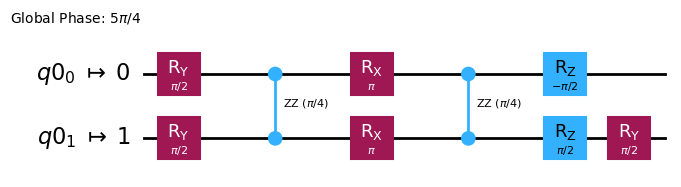
We obtain our transpiled circuit: isa_circ that is formally equivalent to the original one, i.e. they are described by the same unitary quantum channel, something that we can check using the module qiskit.quantum_info:
from qiskit.quantum_info import Operator, average_gate_fidelity

# the transpilation process might modify the ordering between physical and logical qubits
# the function from_circuit takes into account the layout of the transpiled circuit to ensure consistent ordering
print(
    "Fidelity between circuit and ISA circuit:",
    average_gate_fidelity(Operator.from_circuit(circ), Operator.from_circuit(isa_circ)),
)
Fidelity between circuit and ISA circuit: 0.9999999999999996
1.3. Pulse transpilation
We now compute the required pulses thats implement isa_circ by parameterizing the Hamiltonians of the spin-qubit model to construct the circuit.
The PulseCircuit class performs this task based on the hardware specifications and automatically computes the pulse durations required to implement the rotation gates \(R_{X,Y,Z}\) and \(R_{ZZ}\) of the model.
Note that, in this example, idle times are automatically inserted to synchronize the qubits at each circuit layer.
from spin_pulse import PulseCircuit

pulse_circuit = PulseCircuit.from_circuit(isa_circ, hardware_specs)
pulse_circuit.plot(hardware_specs=hardware_specs)
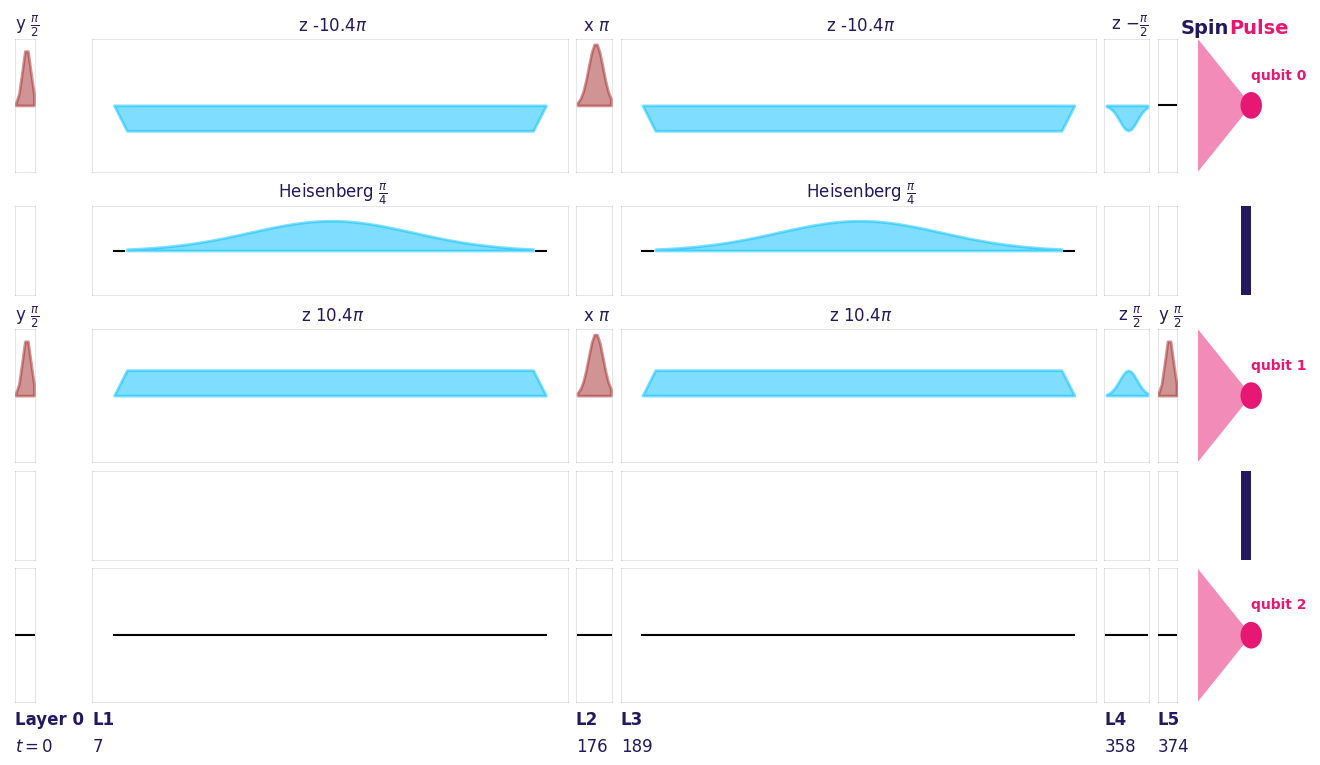
In this illustration, the red pulses correspond to single-qubit gates driven by an oscillating magnetic field, while the blue pulses correspond to two-qubit gates implemented via a \(J\)-coupling (Heisenberg) pulse. The delta (z) ramp defined in the gate is also shown in blue.
The pulse shapes are Gaussian for both the oscillating magnetic-field drive and the \(J\)-coupling pulse, as specified in the hardware configuration.
Pulse durations and amplitudes are determined from the hardware specifications provided when initializing the HardwareSpecs object.
1.4. Numerical integration
The function to_circuit integrates these pulses to obtain the implemented circuit as a sequence of unitary matrices representing each gate. This is the standard way to represent a quantum circuit, in particular using the class qiskit’s QuantumCircuit that we use here.
implemented_circ = pulse_circuit.to_circuit()
implemented_circ.draw("mpl", style="textbook")
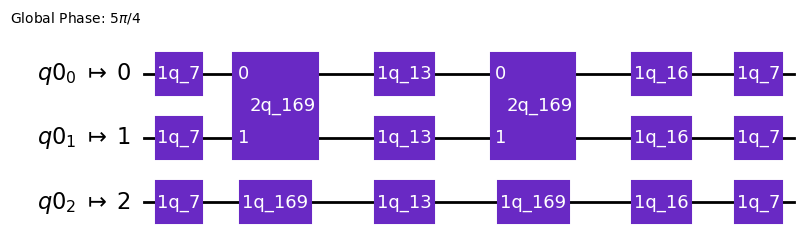
Having such a gate-based description allows to use qiskit functions to evaluate directly some metrics, such as the fidelity with the original circuit.
Here the fidelity deviates from unity to the presence of small non-adiabatic contribution in the realization of the two qubit gate. We provide the function pulse_circuit.fidelity to evaluate this metric directly from the pulse circuit.
print(
    "Fidelity between our implemented circuit and the original circuit ",
    average_gate_fidelity(
        Operator.from_circuit(implemented_circ), Operator.from_circuit(circ)
    ),
    "\nUsing the fidelity function ",
    pulse_circuit.fidelity(),
)
Fidelity between our implemented circuit and the original circuit  0.9999996570953975
Using the fidelity function  0.9999996570953975
1.5. Noise-Accurate Simulations
An experimental environment can be initialized using the ExperimentalEnvironment class.
Here, we define the noise as PINK, which is an important noise characteristic of spin qubits, with a coherence time \(T_2^* = 500\).
We also set the total duration of the time trace to duration = 2**15, equal to the native time segment_duration = 2**15.
The parameter segment_duration because it determines the frequency components present in the signal.
Attaching an experimental environment to a pulse circuit introduces noisy time traces on each qubit.
from spin_pulse.environment.experimental_environment import (
    ExperimentalEnvironment,
)

exp_env = ExperimentalEnvironment(
    hardware_specs=hardware_specs,
    noise_type=NoiseType.PINK,
    T2S=500,
    duration=2**15,
    segment_duration=2**15,
)
pulse_circuit_noise = PulseCircuit.from_circuit(
    isa_circ, hardware_specs, exp_env=exp_env
)
pulse_circuit_noise.plot(hardware_specs)
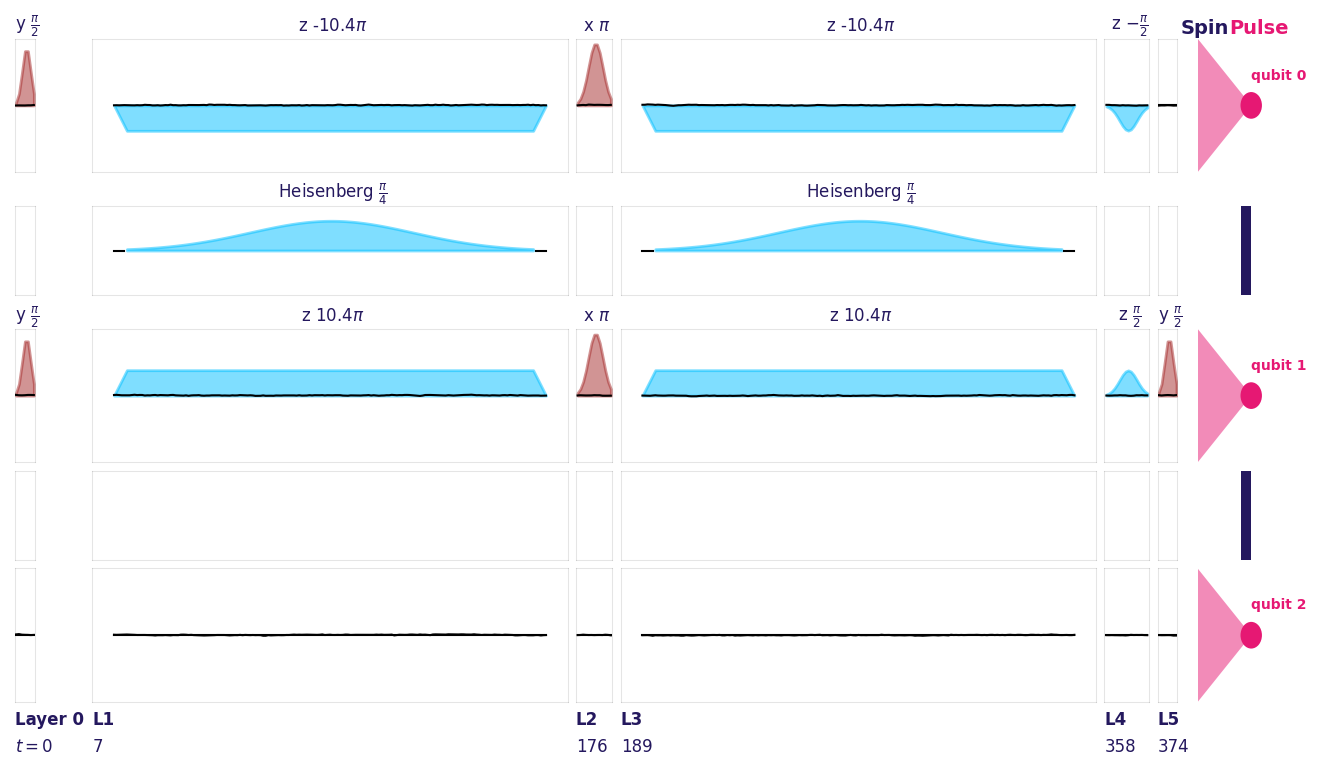
By averaging over multiple circuit executions within the experimental environment, we can access relevant metrics of the model, such as the mean fidelity with respect to the original circuit.
print("Average circuit fidelity ", pulse_circuit_noise.mean_fidelity(exp_env))
Average circuit fidelity 0.9000131955178609
1.6. Switching to square pulses
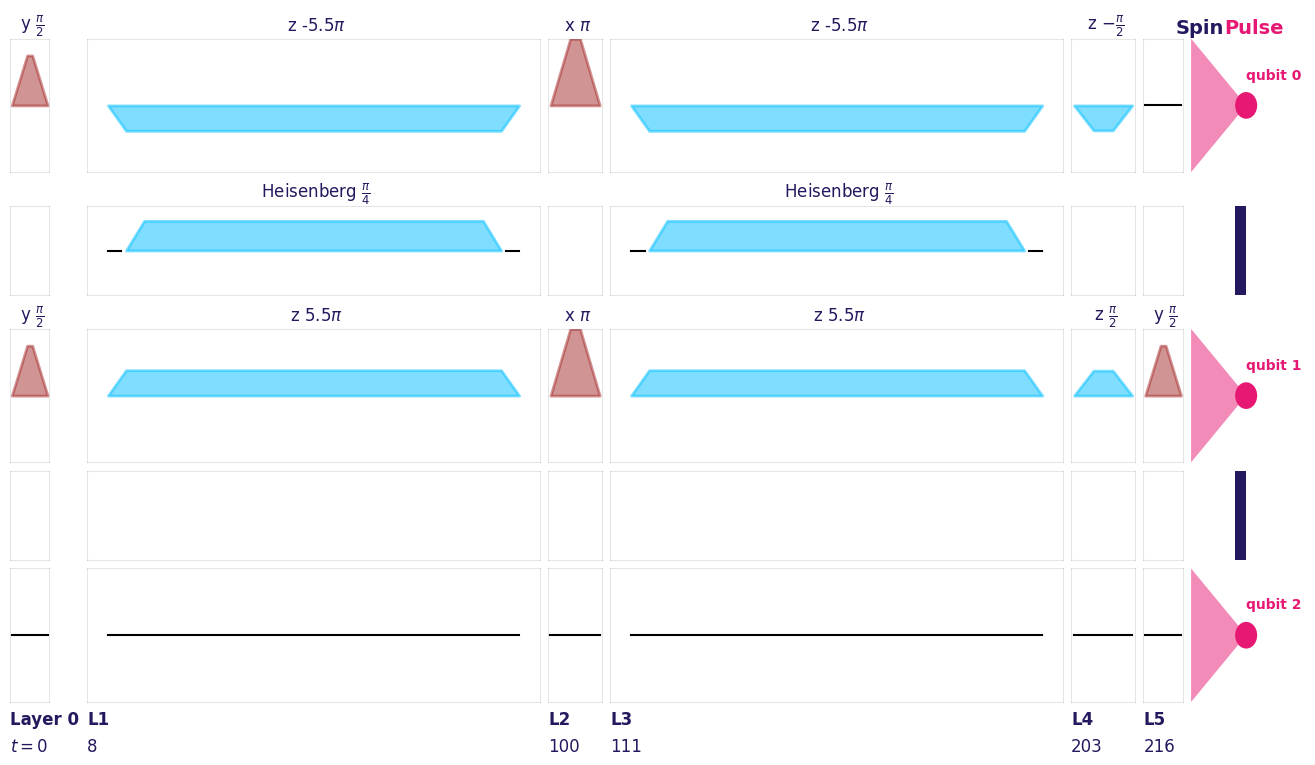
Through a simple argument change, we can change the shapes of our pulses from Gaussian to Square, and repeat the same calculations.
ramp_duration_square = 4
hardware_specs_square = HardwareSpecs(
    num_qubits, B_field, delta, J_coupling, Shape.SQUARE, ramp_duration_square
)
pulse_circuit_square = PulseCircuit.from_circuit(isa_circ, hardware_specs_square)
print(
    "Fidelity between our implemented circuit and the original circuit ",
    pulse_circuit_square.fidelity(),
)
pulse_circuit_square.plot(hardware_specs)
Fidelity between our implemented circuit and the original circuit 0.9999557548862958
1.7. Dynamical decoupling
Finally, the dynamical_decoupling optional argument in the HardwareSpecs constructor allows to replace idle sequences by single-qubit rotations, in order to protect the qubit from the low frequency part of the time traces (the high-frequency part being still present and affecting coherence).
from spin_pulse import DynamicalDecoupling

hardware_specs_dd = HardwareSpecs(
    num_qubits,
    B_field,
    delta,
    J_coupling,
    Shape.GAUSSIAN,
    dynamical_decoupling=DynamicalDecoupling.SPIN_ECHO,
)
pulse_circuit_dd = PulseCircuit.from_circuit(
    isa_circ, hardware_specs_dd, exp_env=exp_env
)
pulse_circuit_dd.plot(hardware_specs)
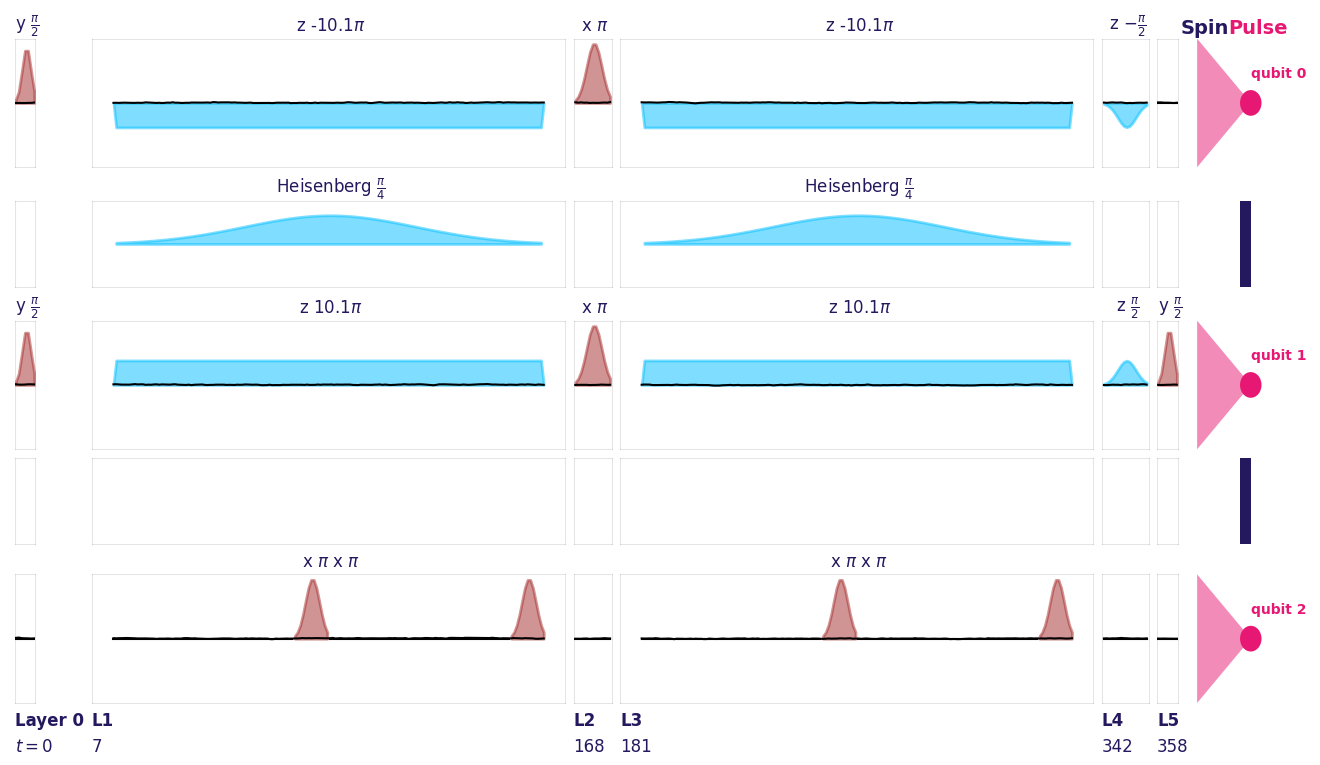
We obtain a significant improvement
print(
    "Average circuit fidelity without DD:",
    pulse_circuit_noise.mean_fidelity(exp_env),
)
print(
    "Average circuit fidelity with DD:",
    pulse_circuit_dd.mean_fidelity(exp_env),
)
Average circuit fidelity without DD: 0.9000131955178609
Average circuit fidelity with DD: 0.9671248823875452